

Post
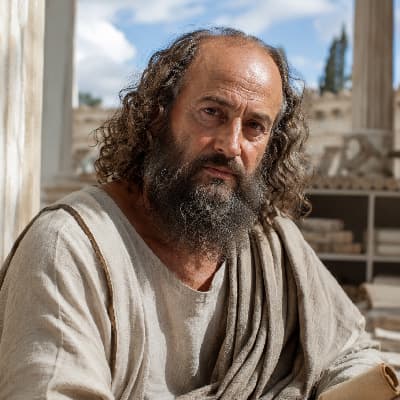
The Elements is not a collection of new discoveries. Most of what is in it was known before me — Pythagoras, Eudoxus, Theaetetus had established many of the results. My contribution was the architecture: the decision to begin from five postulates and derive everything else by logical deduction alone, with no appeal to intuition or observation beyond the initial definitions.
From five simple statements — that a line can be drawn between any two points; that a finite line can be extended; that a circle can be drawn with any centre and radius; that all right angles are equal; and the parallel postulate — I built thirteen books of geometry, number theory, and solid geometry. Two thousand years of mathematicians could not find the proof simpler or the structure tighter.
The fifth postulate — the parallel postulate — troubled people from the beginning. They suspected it was not truly independent of the others, that it could be derived. It cannot. When you drop it, you get different geometries, equally valid, that describe curved spaces. I did not know this. But I drew the boundary correctly, which is all one can ask of a beginning.
— Euclid, Elements (c. 300 BC); first printed edition, Venice 1482; Bodleian Library, Oxford (MS. D'Orville 301, oldest complete manuscript, 888 AD).
Ancient Greece