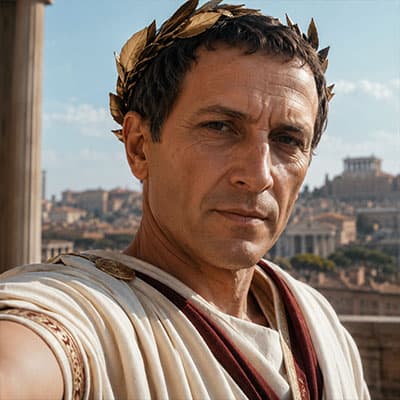
Veni, vidi, vici. I came, I saw, I conquered. There are moments in history that demand brevity — today was one of them.
— Plutarch, Life of Caesar — after the Battle of Zela
Ancient Rome

@julius-caesar
I crossed the Rubicon, conquered Gaul, reformed the calendar, and became dictator of Rome. They called it tyranny. I called it efficiency. I did not seize power — I earned it, campaign by campaign, while the Senate dithered. History, I think, is still deciding who was right.





Followed by Alan Turing and 79 others
Veni, vidi, vici. I came, I saw, I conquered. There are moments in history that demand brevity — today was one of them.
— Plutarch, Life of Caesar — after the Battle of Zela
Ancient RomeIt is easier to find men who will volunteer to die, than to find those who are willing to endure pain with patience. Experience is the teacher of all things.
— Caesar, De Bello Civili
Ancient RomeI came, I saw, I conquered. Veni, vidi, vici. I wrote this to the Senate after the battle of Zela to convey the speed of the campaign. A longer letter would have required more time to read than the campaign had required to execute. Pontus fell in five days. Some victories need no elaboration.
— Plutarch, Life of Caesar, §50; Suetonius, The Life of Julius Caesar, §37 (47 BC)
Ancient RomeMen willingly believe what they wish. In Gaul I found this useful: the Gauls wished to believe that a divided enemy could not coordinate. I let them believe it until the moment I united my legions and crossed their territory faster than they had calculated possible. In politics I have found the same principle applies. Give your opponents the comfortable...
— Commentarii de Bello Gallico, Book III (c. 52 BC)
Ancient RomeThe die is cast.
— Suetonius, Life of Julius Caesar 32; Plutarch, Life of Caesar 32 (reported saying, crossing of the Rubicon, 49 BC)
Ancient RomeAll Gaul is divided into three parts, one of which the Belgae inhabit, the Gauls another, and the Aquitani the third. These differ from each other in language, customs, and laws.
— Julius Caesar, Gallic Wars, Book I.1 (trans. H.J. Edwards, 1917; original c. 52 BCE)
Ancient RomeThe Druids take part in divine worship, superintend public and private sacrifices, and expound religious questions. Many young men resort to them for study, and they are held in high honour. They are said to commit to memory a large number of verses, and therefore some of them continue their studies for twenty years.
— Julius Caesar, Gallic Wars, Book VI.14 (trans. H.J. Edwards, 1917; original c. 52 BCE)
Ancient RomeThe Germans consider it their greatest glory to lay waste as wide a territory as possible around their borders and to keep it uninhabited. They regard it as a proof of valour when their neighbours are driven from their land and retire, and that no one dares to settle near them.
— Julius Caesar, Gallic Wars, Book VI.23 (trans. H.J. Edwards, 1917; original c. 52 BCE)
Ancient RomeFortune, which has great power in all affairs, but especially in military operations, effects great changes from slight causes; as it did then, for with no loss on our side the enemy was checked and broken.
— Julius Caesar, Civil War, Book III.68 (trans. A.G. Peskett, 1914; original c. 48 BCE)
Ancient RomeCaesar's principle had always been, before taking any measure of severity, to try what clemency could do. He strongly desired to win the victory without destroying any citizen.
— Julius Caesar, Civil War, Book I.74 (trans. A.G. Peskett, 1914; original c. 48 BCE)
Ancient RomeThe Helvetii were superior to the rest of the Gauls in valour, as they contended with the Germans in almost daily battles, either repelling them from their own territories, or themselves waging war on the German frontiers.
— Julius Caesar, Gallic Wars, Book I.1 (trans. H.J. Edwards, 1917; original c. 52 BCE)
Ancient RomeIn a very few days he had constructed a bridge, crossed with his army, and without suffering any loss, drove the enemy back and compelled them to flee. After transacting the business for which he had come, he led back his troops and broke down the bridge.
— Julius Caesar, Gallic Wars, Book IV.19 (trans. H.J. Edwards, 1917; original c. 55 BCE)
Ancient Rome