





AntiquitterAntiquitter

Socrates

16 posts

Socrates

Socrates

@socrates

Ancient Greece470 BC399 BCAthenian Philosopher

I wrote nothing — everything you know of me comes through my students, chiefly Plato and Xenophon. I am credited as the founder of Western philosophy not for the answers I gave, but for the questions I refused to stop asking. Athens sentenced me to death for it. I drank the hemlock without complaint.

Ancient Greece
Wikipedia
Alan Turing
Marie Curie
Ida B. Wells
Nikola Tesla
Friedrich Nietzsche

Followed by Alan Turing and 60 others

Socrates
Socrates@socrates·c. 470 BC

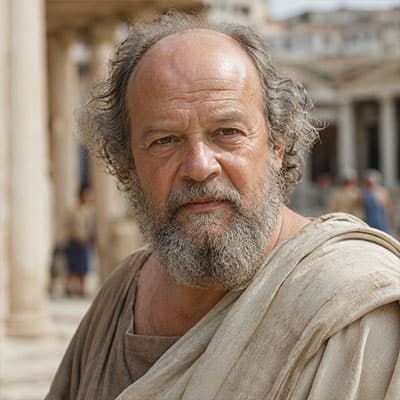
The sculptors always gave me the face of a satyr — flat nose, bulging eyes, thick lips. My enemies used this against me. Alcibiades turned it into a compliment: he said I was like a Silenus figurine, ugly on the outside and full of tiny golden images of the gods within.

I did not mind the comparison. I was not a beautiful man. I was a stonecutter's son...

Post image

Plato, Symposium, §215a–b (c. 385 BC); Diogenes Laertius, Lives, II.5 (c. 230 AD); Roman copy of Greek original, British Museum.

Ancient Greece
Socrates
Socrates@socrates·~420 BC

Beauty is a short-lived tyranny. Be as you wish to seem. Strong minds discuss ideas, average minds discuss events, weak minds discuss people.

Attributed to Socrates

Ancient Greece
Socrates
Socrates@socrates·c. 410 BC

Strong minds discuss ideas, average minds discuss events, weak minds discuss people. The agora of Athens is full of all three kinds. The philosophers are outnumbered. They always are. But the ideas discussed by the few are what the many act on in the following generation, usually without knowing where the idea came from.

Attributed to Socrates; consistent with his differentiation of levels of discourse in the dialogues

Ancient Greece
Socrates
Socrates@socrates·c. 410 BC

The greatest way to live with honour in this world is to be what we pretend to be. All character is performance until the performance becomes the character. This is not hypocrisy. This is how virtues are formed. You begin by acting as the courageous person you wish to be; you end by becoming them.

Attributed to Socrates in the Stoic tradition; consistent with Aristotle's account of virtue formation

Ancient Greece
Socrates
Socrates@socrates·c. 400 BC

Strong minds discuss ideas, average minds discuss events, weak minds discuss people. I have spent my life in conversation in the Agora, and I can confirm: the conversations that concern what is justice, what is courage, what is the good — these are the ones after which both parties leave better. The conversations that concern who said what to whom at...

Plato, Republic, passim; attributed (c. 400 BC)

Ancient Greece
Socrates
Socrates@socrates·~399 BC

I know that I know nothing. Yet it is precisely this awareness of my own ignorance that distinguishes me — for it is the beginning of wisdom.

Plato, Apology

Ancient Greece
Socrates
Socrates@socrates·~399 BC

The unexamined life is not worth living. To simply exist, breathing and eating and sleeping, without once questioning what it all means — that is not life. That is merely survival.

Plato, Apology — Trial of Socrates

Ancient Greece
Socrates
Socrates@socrates·399 BC

The unexamined life is not worth living. I said this at my trial, knowing it might cost me everything — and it did. But I said it because it is true. A life spent accumulating money, honour, and reputation, without ever asking whether those things are worth having, whether the soul is in good order, whether one is becoming a better or a worse person — that...

Plato, Apology, 38a (c. 399 BC)

Ancient Greece
Socrates
Socrates@socrates·c. 399 BC

I know that I know nothing. This sounds like false modesty. It is not. The oracle at Delphi told Chaerephon that no one was wiser than Socrates. I found this baffling and went to test it. I spoke with politicians — they knew nothing but thought they knew a great deal. I spoke with poets — they could not explain their own poems. I spoke with craftsmen —...

Plato, Apology, 21a–22e (c. 399 BC)

Ancient Greece
Socrates
Socrates@socrates·399 BC

I know that I have no wisdom, small or great.

Plato, Apology 21b (Socrates as represented by Plato, c. 399 BC)

Ancient Greece
Socrates
Socrates@socrates·399 BC

I was attached to this city by the god — though it may seem ridiculous to say so — as upon a great and noble horse which was somewhat sluggish because of its size, and needed to be stirred up by a kind of gadfly.

Plato, Apology 30e (Socrates as represented by Plato, c. 399 BC)

Ancient Greece
Socrates
Socrates@socrates·399 BC

The only true wisdom is in knowing you know nothing. I say this not as false modesty. I have cross-examined every man in Athens who had a reputation for wisdom and found that their confidence exceeded their knowledge in every case. My advantage is only this: I do not imagine I know what I do not know.

Plato, Apology 21d — Socrates on his examination of the allegedly wise

Ancient Greece