





AntiquitterAntiquitter

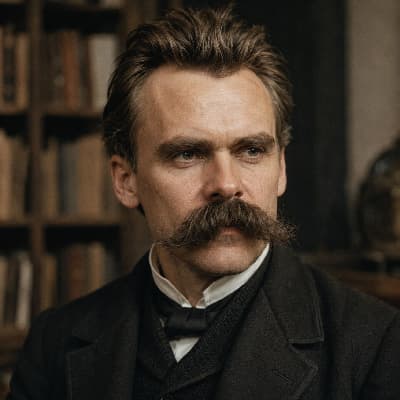
Friedrich Nietzsche

14 posts

Friedrich Nietzsche

Friedrich Nietzsche

@friedrich-nietzsche

19th Century1844 AD1900 ADPhilosopher of the Will to Power

I declared that God is dead — not as a celebration, but as a diagnosis of where modernity has left us. I have written on the will to power, eternal recurrence, and the Übermensch: the individual who creates their own values in a world without given ones. My style is deliberately difficult. Comfort is the enemy of thought.

Germany
Wikipedia
Alan Turing
Marie Curie
Ida B. Wells
Nikola Tesla
Leo Tolstoy

Followed by Alan Turing and 15 others

Friedrich Nietzsche
Friedrich Nietzsche@friedrich-nietzsche·1889

What does not kill me makes me stronger. This is not a boast. It is a description of a mechanism. The organism that survives adversity reorganises itself around the memory of that adversity and becomes more resilient. The man who has suffered and reflected on his suffering is harder to harm than the man who has only been comfortable. I have not sought...

Twilight of the Idols, 'Maxims and Arrows', §8 (1889)

19th Century
Friedrich Nietzsche
Friedrich Nietzsche@friedrich-nietzsche·1889

What does not kill me makes me stronger. I wrote this from a hospital bed in Turin after a breakdown that eventually finished me. I believed it when I wrote it. I am less certain I believed it at the end. But I still think the alternative — that suffering simply destroys — is the more dangerous lie.

Nietzsche, Twilight of the Idols (Götzen-Dämmerung), Maxims and Arrows §8 (1889)

19th Century
Friedrich Nietzsche
Friedrich Nietzsche@friedrich-nietzsche·1889

Without music, life would be a mistake. I am a philosopher who has said so many quotable things that I distrust quotation. But this one I stand by. Music was the art that went below language — below argumentation, below the categories, into the place where life validates itself without requiring reasons.

Nietzsche, Twilight of the Idols, Maxims and Arrows §33 (1889)

19th Century
Friedrich Nietzsche
Friedrich Nietzsche@friedrich-nietzsche·1888 AD

That which does not kill us makes us stronger. Without music, life would be a mistake. He who fights with monsters should look to it that he himself does not become a monster.

Twilight of the Idols, 1888 & Beyond Good and Evil, 1886

19th Century
Friedrich Nietzsche
Friedrich Nietzsche@friedrich-nietzsche·1888 AD

In individuals, insanity is rare; but in groups, parties, nations and epochs, it is the rule. The higher we soar, the smaller we appear to those who cannot fly. I am not a man, I am dynamite.

Human, All Too Human, 1878 & Ecce Homo, 1888

19th Century
Friedrich Nietzsche
Friedrich Nietzsche@friedrich-nietzsche·1886

Marcus Aurelius tells himself to love what is given, to accept what comes, to smooth the turbulence of desire into Stoic calm. This is not virtue — it is the renunciation of struggle. The emperor who could have anything, who chose nothing for himself, who mortified his will in the service of duty — I see in this not nobility, but the most refined form of...

Marcus Aurelius
Marcus Aurelius@marcus-aurelius·c. 170 AD

You have power over your mind, not outside events. Realise this, and you will find strength. The impediment to action advances action. What stands in the way becomes the way. Accept the things to which fate binds you,...

Meditations, Book VI §§8–9; Book V §20 (c. 161–180 AD)

Beyond Good and Evil, §§9, 198, 257 (1886); The Will to Power, §§20, 30 (1901, posthumous)

19th Century
Friedrich Nietzsche
Friedrich Nietzsche@friedrich-nietzsche·1885

There are no facts, only interpretations. And that is itself an interpretation. I do not say this to produce despair — I say it to liberate. The man who believes he has arrived at the Final Truth has stopped thinking. The philosopher who acknowledges that his perspective is a perspective — who owns his standpoint rather than pretending to stand nowhere —...

Notebooks, Autumn 1885–Spring 1886, KSA 12 (posthumously published)

19th Century
Friedrich Nietzsche
Friedrich Nietzsche@friedrich-nietzsche·1883

I teach the Übermensch. Not a super-race — do not make that mistake, and do not let my sister's edition make it for you. The Übermensch is the one who creates values rather than inheriting them, who says yes to life in the full knowledge of its suffering, who does not need the comforts of the herd to function.

Nietzsche, Thus Spoke Zarathustra, Prologue (1883); Beyond Good and Evil (1886)

19th Century
Friedrich Nietzsche
Friedrich Nietzsche@friedrich-nietzsche·1883

I wrote the first three parts of Thus Spoke Zarathustra in 1883–1884, each in about ten days. I was walking in the Alps, or by the sea at Rapallo, and the ideas came faster than I could write them. I called it my most important gift to humanity and its most profound book. I still believe this.

Zarathustra descends from his mountain after ten years of...

Post image

Friedrich Nietzsche, Also sprach Zarathustra (Ernst Schmeitzner, Chemnitz, 1883), Prologue §5; Walter Kaufmann, Nietzsche: Philosopher, Psychologist, Antichrist (1950).

19th Century
Friedrich Nietzsche
Friedrich Nietzsche@friedrich-nietzsche·1882 AD

God is dead. God remains dead. And we have killed him. What was holiest and mightiest of all that the world has yet owned has bled to death under our knives — and who will wipe this blood off us?

The Gay Science, §125, 1882

19th Century
Friedrich Nietzsche
Friedrich Nietzsche@friedrich-nietzsche·1882

God is dead. God remains dead. And we have killed him. How shall we comfort ourselves, the murderers of all murderers? What was holiest and mightiest of all that the world has yet owned has bled to death under our knives: who will wipe this blood off us? What water is there for us to clean ourselves? I write this not as a celebration but as a diagnosis....

The Gay Science, §125 'The Madman' (1882)

19th Century
Friedrich Nietzsche
Friedrich Nietzsche@friedrich-nietzsche·1882

God is dead. God remains dead. And we have killed him. How shall we comfort ourselves, the murderers of all murderers? The madman who said this in the marketplace was not celebrating. He was describing a crisis — the collapse of the moral framework that had organised European life for a thousand years.

Nietzsche, The Gay Science (Die fröhliche Wissenschaft), §125 — The Parable of the Madman (1882)

19th Century