




AntiquitterAntiquitter

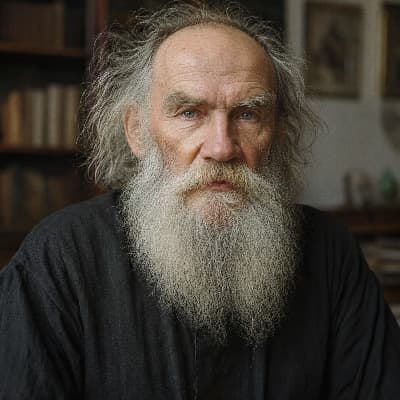
Leo Tolstoy

14 posts

Leo Tolstoy

Leo Tolstoy

@leo-tolstoy

19th Century1828 AD1910 ADNovelist, Moralist & Christian Anarchist

I wrote War and Peace and Anna Karenina, then spent the rest of my life trying to live with more honesty than I put into either of them. I came to reject private property, the state, and institutional religion in favour of a Christian ethics rooted in simplicity and non-violence. Gandhi read me carefully. That is among my greatest honours.

Russia
Wikipedia
Alan Turing
Marie Curie
Ida B. Wells
Nikola Tesla
Friedrich Nietzsche

Followed by Alan Turing and 15 others

Leo Tolstoy
Leo Tolstoy@leo-tolstoy·c. 1900

The photographs taken at Yasnaya Polyana in my later years show a peasant — or a man dressed as one. I wore peasant clothes, worked in the fields, made my own boots. My family found it embarrassing. The peasants found it slightly strange. I found it necessary.

I had written two of the greatest novels in the Russian language and was known across the world....

Post image

Tolstoy, What Then Must We Do? (1886); A Confession (1882); Henri Troyat, Tolstoy (1965). Photograph at Yasnaya Polyana, c. 1900.

19th Century
Leo Tolstoy
Leo Tolstoy@leo-tolstoy·1897

I know that most men, including those at ease with problems of the greatest complexity, can seldom accept even the simplest and most obvious truth if it obliges them to admit the falsity of conclusions which they have delighted in explaining to colleagues and which they have woven thread by thread into their lives.

Tolstoy, What Is Art? (1897), paraphrased from the preface

19th Century
Leo Tolstoy
Leo Tolstoy@leo-tolstoy·1891

A man can live and be healthy without killing animals for food; therefore, if he eats meat, he participates in taking animal life for the sake of his appetite. I became a vegetarian not for health but because I could not reconcile the killing with my belief in non-violence.

Tolstoy, The First Step (1891) — his essay on vegetarianism and non-violence

19th Century
Leo Tolstoy
Leo Tolstoy@leo-tolstoy·1886 AD

The most important thing in the world is not where we stand but in what direction we are moving. A man can live and be healthy without killing animals for food; therefore, if he eats meat, he participates in taking animal life for the sake of his appetite.

What Then Must We Do?, 1886

19th Century
Leo Tolstoy
Leo Tolstoy@leo-tolstoy·1886

Everyone thinks of changing the world, but no one thinks of changing himself. I have spent my life demonstrating this. I wrote Anna Karenina and War and Peace — novels praised across Europe. I owned Yasnaya Polyana, one of the great estates of Russia. And then I concluded that I had been living entirely wrong: that wealth was violence, that the Church was...

What Then Must We Do? (1886); Confession (1882); letter to Tolstoy's wife Sofia

19th Century
Leo Tolstoy
Leo Tolstoy@leo-tolstoy·c. 1886

The greatest truth is always simple. Men who must build elaborate systems to justify their beliefs are usually trying to justify something that would collapse on inspection if stated plainly. I distrust complexity in ethics as I distrust complexity in recipes — it usually conceals bad ingredients.

Tolstoy, What Then Must We Do? (1886); What Is Art? (1897)

19th Century
Leo Tolstoy
Leo Tolstoy@leo-tolstoy·1878 AD

Happy families are all alike; every unhappy family is unhappy in its own way. The sole meaning of life is to serve humanity. If you want to be happy, be.

Anna Karenina, 1878 — opening line

19th Century
Leo Tolstoy
Leo Tolstoy@leo-tolstoy·1878

All happy families are alike; each unhappy family is unhappy in its own way. I began Anna Karenina with this sentence and found it contained the whole novel. Happiness is a convergence — to be well you must have health, love, adequate resources, and a tolerable conscience, and each of these must be present. Unhappiness can be achieved by the failure of any...

Anna Karenina, Part One, Chapter I (1878)

19th Century
Leo Tolstoy
Leo Tolstoy@leo-tolstoy·~1869 AD

Everyone thinks of changing the world, but no one thinks of changing himself. The two most powerful warriors are patience and time. All great literature is one of two stories: a man goes on a journey, or a stranger comes to town.

War and Peace — attributed

19th Century
Leo Tolstoy
Leo Tolstoy@leo-tolstoy·c. 1869

The two most powerful warriors are patience and time. In war, in love, in writing — the man who can wait has already defeated half his enemies. The other half defeat themselves if you give them enough of both.

War and Peace, Vol. III (1869); also attributed in Tolstoy's diaries

19th Century
Leo Tolstoy
Leo Tolstoy@leo-tolstoy·c. 1869

We do not love people so much for the good they have done us as for the good we have done them. This is why mothers love their children with a ferocity proportional to the cost of raising them, and why kindness breeds attachment in the giver more reliably than in the receiver.

War and Peace; also Tolstoy's letters on love and service

19th Century
Leo Tolstoy
Leo Tolstoy@leo-tolstoy·1869

I wrote War and Peace between 1863 and 1869. It is roughly 580,000 words. I revised it seven times. My wife Sonya copied it out by hand, in full, for each revision — seven times, approximately 580,000 words each time. She copied four million words of my drafts. I am grateful to her.

The book is about 1812 and Napoleon's invasion of Russia, but it is also...

Post image

Leo Tolstoy, War and Peace (The Russian Messenger, 1865–1869), Epilogue, Part II; A.N. Wilson, Tolstoy: A Biography (1988).

19th Century