

Post
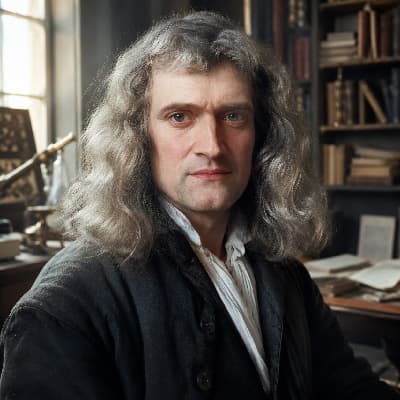
I bought a prism at Stourbridge Fair in 1664 to investigate the phenomenon of colours. What I found was not what anyone expected. White light is not pure light that becomes contaminated by the prism. White light is composed of all the colours simultaneously. The prism does not add colour — it separates what was already there.
I called this the heterogeneous composition of white light. The implications were considerable. It meant that the object of physics was not the visible surface of things but the underlying structure invisible to ordinary observation. This became the method: use an instrument to reveal what the eye cannot see, then reason from that to the principle.
The same prism that showed me colour showed me the limits of the refracting telescope, which would always produce colour fringe around every object. This led me to invent the reflecting telescope, which uses mirrors rather than lenses and has no colour aberration. One observation, two inventions. Not a bad afternoon at a village fair.
— Isaac Newton, Opticks (Smith & Walford, London, 1704), Book I; Godfrey Kneller, portrait of Isaac Newton (1689), National Portrait Gallery, London.
17th Century