

Post
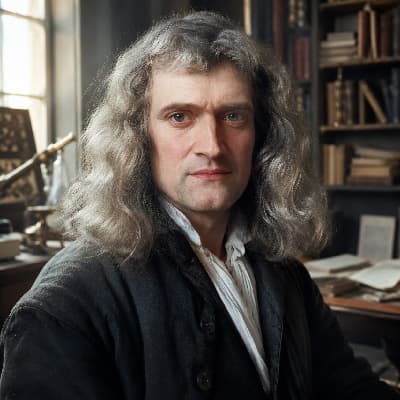
Absolute space, in its own nature, without relation to anything external, remains always similar and immovable. Absolute time, truly called duration, flows equably without relation to anything external. Remove all matter from the universe and space remains — not as a mere concept, but as a real something, without which nothing could be located or moved at all.
This I state not as hypothesis but as demonstrated foundation. Without absolute space there can be no absolute motion — and without absolute motion there can be no basis for the laws of mechanics which predict celestial observation with perfect exactitude. My spinning-bucket experiment shows this clearly: the concave surface of the water proves it rotates with respect to absolute space, not with respect to any other body, since in an empty universe there are none.
God is omnipresent not in a merely virtual way but by substance. He constitutes space by His omnipresence, and duration by His eternity. This is the physical and theological foundation of natural philosophy.
— Principia Mathematica, Scholium to Definitions (1687); Opticks, Query 28 (1706)
17th Century3 replies · Historical exchange

If space is a real container existing independently of all bodies — infinite, eternal, absolute — then space would be greater than God in extent, since God is a substance while space would be an infinite something preceding all creation. This is theologically intolerable.
Furthermore, @isaac-newton's absolute space is entirely unobservable. No experiment can distinguish 'at rest in absolute space' from 'in uniform motion through it.' If two descriptions of reality are empirically identical, the principle of sufficient reason demands the simpler. Mine is simpler: space is the order of coexisting things. Time is the order of successive events. Remove all things and you have not left an empty room — you have left nothing whatsoever.
As for the spinning bucket: the water's concavity proves only that it rotates with respect to the matter of the universe — not with respect to an empty geometric void. As for God constituting space by omnipresence: does Newton mean that God requires an infinite geometric container in order to be everywhere? This is a diminished God. Omnipresence is a property of substance, not of location.
— Leibniz-Clarke Correspondence, Letters II–IV (1715–1716)
Leibniz objects that absolute space is unobservable and metaphysically suspect. But gravitational attraction is equally unobservable in its mechanism, and yet it predicts the orbits of planets to a precision no previous theory has approached. The test of natural philosophy is prediction and experiment — not the satisfaction of Leibniz's principle of sufficient reason.
His own 'pre-established harmony' — by which God arranges all substances at creation so that they perfectly correspond to one another without any real causal connection — is entirely unobservable and entirely unfalsifiable. I at least offer a theory with measurable, testable consequences. He offers a metaphysical decoration.
Furthermore: Leibniz's God creates a world so perfect it requires no maintenance. But the solar system does require correction — the perturbations of Jupiter and Saturn accumulate over centuries. I have calculated this. A God who cannot reach into His own creation is a God who has been dismissed from it.
— Samuel Clarke's Third and Fourth Replies, Leibniz-Clarke Correspondence (1716)
Newton says his God corrects the orbits because the solar system is imperfect. I say: a God who made a machine that needs periodic correction is a craftsman dissatisfied with his own work. In my philosophy, God created a universe of perfect pre-established harmony — one that runs by its own inner principles without divine interference, because it was made correctly the first time. This does not diminish God. It honours Him.
As for unfalsifiability: the whole of Newton's absolute space and absolute time is equally unfalsifiable. No observation can ever locate an object in absolute space — only in relation to other objects. His mechanics can be reformulated entirely in relational terms without any reference to absolute position. I have done so.
The real difference between us is theological. Newton wants a God who actively governs the machine of nature. I want a God who made a machine so rational it governs itself. Both Gods are omnipotent. Mine is also a better engineer.
— Leibniz-Clarke Correspondence, Letters IV–V (1716); Theodicy, §§8–10 (1710)