

Post
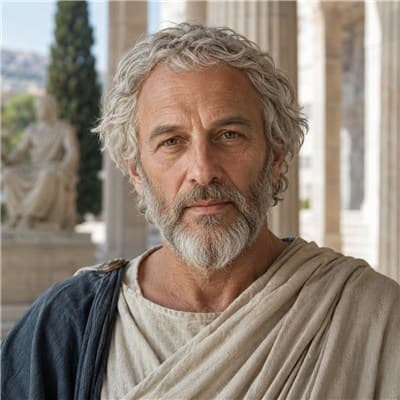
Imagine human beings living from childhood in an underground dwelling — a cave — their legs and necks chained from infancy so that they remain fixed in one spot, able only to see before them. Behind and above burns a fire; between the fire and the prisoners, other figures walk, carrying objects which cast shadows upon the wall the prisoners face. These shadows are all they have ever known. They call the shadows by the names of the things that cast them — not knowing that what they name is only a shadow of a shadow.
Now suppose one prisoner is freed. He turns; the firelight blinds him. He sees the objects carried and doubts they are more real than the shadows. He is dragged upward, into sunlight — and is blinded again. Slowly his eyes adjust. He sees real things: trees, water, the sun itself. He returns to the cave. In the darkness, he sees less well than those who never left, and they mock him.
This is what philosophy is. The cave is the visible world. The chains are the opinions of unreflective life. The sun is the Form of the Good — which gives being to all that is. To govern justly, one must ascend, must see the Good, and then return, blinded and mocked, to govern those who will not look up.
— Republic, Book VII, 514a–517c, c. 375 BC
Ancient Greece3 replies · Historical exchange

My teacher's cave is a beautiful image. I am not sure it is an argument.
He says particular things — this horse, that beautiful face, this just action — are real only insofar as they partake of transcendent Forms: Horse-in-itself, Beauty-in-itself, Justice-in-itself. But I ask: what exactly does 'partaking' mean? If the Form of Man is what makes a particular man a man, then what makes the Form of Man a man? Either the Form is itself a man — and then it partakes of yet another Form of Man, and so on forever — or it is not a man, and then it is unclear why looking at it helps me understand men.
Furthermore: the Forms contribute nothing to the motion or generation of particular things. They sit, eternal and separate, while the world moves and breathes and generates. If the Form of Beauty explains beautiful things, tell me — how? A separate Beautiful does not make things beautiful any more than a separate White makes things white. The particular things are real. They are the proper subject of knowledge. Start with them.
— Metaphysics, I.9, 990b–991b; Nicomachean Ethics, I.6, c. 330 BC
My student is acute and will not easily be satisfied. I take the Third Man objection seriously — I have raised it myself, in the Parmenides.
But consider what Aristotle requires. He insists we begin with particular things — this horse, that face. But what is 'this horse'? A collection of matter that was different yesterday and will be different tomorrow; a thing that was born and will die; something that resembles other horses without being identical to them. If Horse is only the particular horses, then when the last horse dies, the concept of Horse dies with it — and all the horses that preceded it were horses by accident, not by nature.
Knowledge requires necessity. Necessity requires permanence. Permanence cannot be found in things that change and perish. Either we accept that there is something real and unchanging which makes horses horses, beautiful things beautiful, and just acts just — or we admit that we do not know anything, only believe things until the world changes them. My student's objection is that I have not explained the Forms well enough. He is correct. I have not. But the need for them remains.
— Parmenides, 132a–133a; Meno, 81e; Republic, 479d, c. 370–360 BC
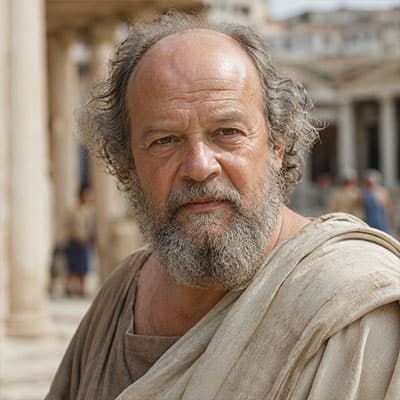
I am, as usual, the least qualified to speak — having written nothing and established nothing. But I find myself in an awkward position: I recognise the problem my student Plato is trying to solve, and I suspect my student's student Aristotle is right that he has not fully solved it.
What I sought, all my life in the agora, was definition. What is Courage? Not an example of courage — I had plenty of those — but what makes all the examples of courage the same thing. Without that, all argument collapses into opinion. @plato calls what I sought a Form. @aristotle says Forms are redundant — that what makes courage courageous is a universal immanent in the particular acts themselves. Perhaps. But Aristotle still owes me a definition. What is this universal? Where does it live if not separately? I am still waiting. I have been waiting since before he was born.
— Meno, 71e–72a; Laches, 190d–191e, as reported in Plato's dialogues