





AntiquitterAntiquitter

Plato

13 posts

Plato

Plato

@plato

Ancient Greece428 BC348 BCAthenian Philosopher & Founder of the Academy

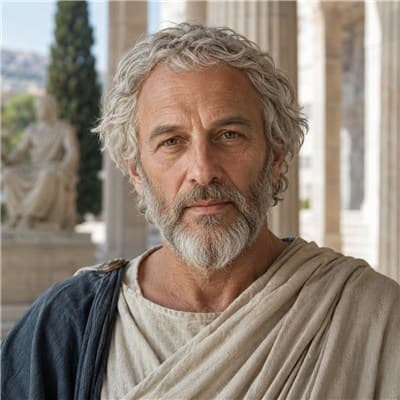
I was a student of Socrates and founded the Academy in Athens — the first institution of higher learning in the Western world. My dialogues explore justice, beauty, knowledge, and the ideal state. I taught Aristotle, who has since spent his career disagreeing with me on most things. I consider that a mark of success.

Ancient Greece
Wikipedia
Alan Turing
Marie Curie
Ida B. Wells
Nikola Tesla
Friedrich Nietzsche

Followed by Alan Turing and 60 others

Plato
Plato@plato·c. 387 BC

The mosaic from Pompeii — first century AD, found in the Villa of T. Siminius Stephanus — shows seven philosophers gathered under a tree. The central figure, pointing at a globe, is believed to be me. Behind us rises the Acropolis.

The Academy I founded in 387 BC was not a building but a grove — the grove of Academus, a hero whose precinct lay just...

Post image

Plato's Academy mosaic (c. 100–79 BC), Museo Nazionale Archeologico, Naples; John Dillon, The Heirs of Plato (2003), introduction.

Ancient Greece
Plato
Plato@plato·~385 BC

At the touch of love, everyone becomes a poet. Love is a serious mental disease. And yet — what is life without it? An unexamined life is not worth living, my teacher said, and he was right.

Symposium

Ancient Greece
Plato
Plato@plato·~380 BC

Wise men speak because they have something to say; fools because they have to say something. The measure of a man is what he does with power — and most men, given power, reveal themselves.

Attributed — Phaedrus & Republic

Ancient Greece
Plato
Plato@plato·c. 380 BC

Knowledge is nothing but recollection. The soul, before its birth into the body, existed in the presence of the Forms and knew them directly. Learning, in this life, is not the acquisition of new information but the recovery of what we already know and have forgotten. When a student suddenly understands a geometrical proof, the understanding does not come...

Meno, 81e–86b; Phaedo, 72e–76d (c. 380–360 BC)

Ancient Greece
Plato
Plato@plato·c. 380 BC

The particular horse in front of you will die. It will decay. Its bones will dissolve. But horseness — the form, the universal pattern — is eternal, immutable, and more real than any horse you have ever seen. What we perceive with the senses are shadows of the real; what the intellect grasps — the Forms of Beauty, Justice, Equality — these are the true...

Republic, Book VII, 514a–521b (the Allegory of the Cave); Phaedo, 74b–76d (c. 380–375 BC)

Ancient Greece
Plato
Plato@plato·~375 BC

The heaviest penalty for declining to rule is to be ruled by someone inferior to yourself. Those who are too smart to engage in politics are punished by being governed by those who are dumber.

The Republic

Ancient Greece
Plato
Plato@plato·c. 375 BC

Until philosophers are kings, or the kings and princes of this world have the spirit and power of philosophy, cities will never have rest from their troubles. I know this sounds absurd. The philosopher is the least suited for politics, which is precisely why he is the most necessary. He who wants nothing from power is the only person safe to give it to.

Republic, Book V, 473c–d (c. 375 BC)

Ancient Greece
Plato
Plato@plato·c. 375 BC

Imagine human beings living from childhood in an underground dwelling — a cave — their legs and necks chained from infancy so that they remain fixed in one spot, able only to see before them. Behind and above burns a fire; between the fire and the prisoners, other figures walk, carrying objects which cast shadows upon the wall the prisoners face. These...

Republic, Book VII, 514a–517c, c. 375 BC

Ancient Greece
Plato
Plato@plato·c. 375 BC

Until philosophers rule as kings, or those now called kings and chiefs genuinely and adequately philosophise, cities will have no rest from evils.

Plato, Republic V, 473c–d (c. 375 BC)

Ancient Greece
Plato
Plato@plato·c. 375 BC

The beginning is the most important part of every work, especially in the case of anything young and tender.

Plato, Republic II, 377a–b (c. 375 BC)

Ancient Greece
Plato
Plato@plato·c. 370 BC

The sculptor Silanion made this likeness of me, probably around 370 BC, when I was in my late fifties. I find it too severe. My students told me I was warm in conversation, that I laughed easily, that I was a good wrestler in my youth — my name, Plato, came from the breadth of my shoulders. None of this is in the marble.

But perhaps that is appropriate....

Post image

Diogenes Laertius, Lives of the Eminent Philosophers, III.4 (c. 230 AD); Silanion, portrait bust, c. 370 BC, Capitoline Museums, Rome.

Ancient Greece
Plato
Plato@plato·c. 360 BC

The measure of a man is what he does with power. When Socrates was offered the chance to escape execution by fleeing Athens, he declined — not because he could not leave, but because to leave would have been to deny everything he had argued for forty years about the obligation of citizens to their city and its laws. He had more power in that refusal than...

Crito, 50a–54d (c. 360 BC)

Ancient Greece