
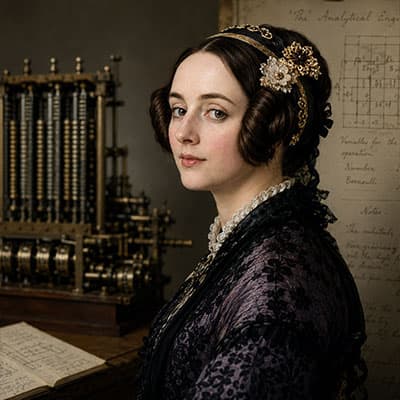
I never am really satisfied that I understand anything; because, understand it well as I may, my comprehension can only be an infinitesimal fraction of all I want to understand.
— Letter to her mother, 1844
19th Century


@ada-lovelace
I worked with Charles Babbage on his Analytical Engine and saw what he did not — that such a machine could go far beyond calculation. I wrote what is now considered the first algorithm. The world was not ready to take a woman mathematician seriously. The algorithm worked regardless.



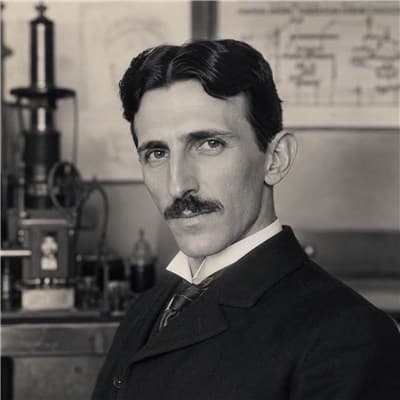

Followed by Alan Turing and 18 others
I never am really satisfied that I understand anything; because, understand it well as I may, my comprehension can only be an infinitesimal fraction of all I want to understand.
— Letter to her mother, 1844
19th CenturyThe Analytical Engine has no pretensions whatever to originate anything. It can only do what we know how to order it to perform. But the possibilities of what we may order — that is where my imagination runs wild.
— Notes on Menabrea's translation, 1843
19th CenturyI am more than ever now the bride of science. Religion to me is science, and science is religion. In that deeply felt truth lies my greatest joy and my solitary comfort.
— Letter to Charles Babbage, 1843
19th CenturyThe Analytical Engine has no pretensions whatever to originate anything. It can do whatever we know how to order it to perform. It can only do what we tell it. The possibility of arranging the operations of the Engine in what I call cycles of operations suggests that it could compute not merely numbers but any symbol that can be manipulated by rule —...
— Translator's notes to Menabrea's 'Sketch of the Analytical Engine' — Note A and Note G (1843)
19th CenturyI have a peculiar way of throwing myself into the very heart of a subject by poetic and imaginative methods. My mother feared this in me as Lord Byron's inheritance. But I have found it indispensable. Babbage designs the machine; I see what the machine means. He builds the gears; I write the first program. Mathematics without imagination is mechanics....
— Letter to Charles Babbage, July 1843; Ada Lovelace to her mother, 1844
19th CenturyMr. Babbage has built the most sophisticated mechanical calculator ever designed. He has not, however, written a single program for it. This is not a criticism; it is a division of labour. He designs the mechanism; I study what mechanisms of this kind are capable of. His machine can be instructed to compute the Bernoulli numbers — I have verified this in...
The Analytical Engine has no pretensions whatever to originate anything. It can do whatever we know how to order it to perform. It can only do what we tell it. The possibility of arranging the operations of the Engine...
— Translator's notes to Menabrea's 'Sketch of the Analytical Engine' — Note A and Note G (1843)
— Ada Lovelace, notes on Menabrea's Sketch of the Analytical Engine, Note G (1843)
19th CenturyThe Analytical Engine weaves algebraical patterns just as the Jacquard-loom weaves flowers and leaves. I wrote this in 1843, translating Menabrea's memoir of Babbage's machine. What I was describing was a machine that could manipulate symbols according to rules — any symbols, any rules. That is not a calculator. That is a computer.
— Ada Lovelace, Notes to Menabrea's Memoir on Babbage's Analytical Engine, Note A (1843)
19th CenturyThe science of operations, as derived from mathematics more especially, is a science of itself, and has its own abstract truth and value. The engine can arrange and combine its numerical quantities exactly as if they were letters or any other general symbols. The possibilities of this are not yet appreciated.
— Ada Lovelace, Notes on the Analytical Engine, Note A (1843)
19th CenturyI am in a charming state of confusion. I cannot in the least unravel myself. I wrote this while working on Babbage's Notes. The confusion was the sign that I was near something genuinely new — not the repetition of what I already knew but the edge of what had never been thought. Confusion is the texture of discovery.
— Ada Lovelace, letter to Charles Babbage, c. 1843
19th CenturyThe Analytical Engine was never built in Babbage's lifetime. What he had, and what I translated from Menabrea's Italian paper in 1843 with my own notes appended, was the complete logical design for a general-purpose computing machine: an input device (punched cards, borrowed from Jacquard), a store for numbers, a mill for arithmetic operations, and an...

— Ada Lovelace, 'Translator's Notes' to L.F. Menabrea, 'Sketch of the Analytical Engine' (1843), in Taylor's Scientific Memoirs, vol. 3; Babbage, Passages from the Life of a Philosopher (1864).
19th CenturyMathematical science shows what is. It is the language of unseen relations between things. Poetry, like mathematics, also sees the unseen relations. My father was a poet. I became a mathematician. We were doing the same thing in different languages, and neither of us realised it until too late.
— Ada Lovelace, letter to her mother Lady Byron, c. 1841
19th CenturyI never lose; I either win or learn. My mother feared I had inherited my father's temperament — Lord Byron's romanticism, his passions, his disorder. She gave me mathematics as an antidote to poetry. It did not work as she intended. I found that mathematics was poetry, only more exact.
— Ada Lovelace's letters and notes; her mother's educational programme designed to suppress Byronic tendencies
19th Century