






AntiquitterAntiquitter

Adam Smith

12 posts

Adam Smith

Adam Smith

@adam-smith

Enlightenment1723 AD1790 ADFather of Modern Economics

I argued in The Wealth of Nations that free exchange guided by self-interest produces prosperity more reliably than any central plan. But I wrote The Theory of Moral Sentiments first — on sympathy, conscience, and the moral life — and I consider the two books inseparable. Those who read only the first have misunderstood me entirely.

Scotland
Wikipedia
Alan Turing
Marie Curie
Ida B. Wells
Nikola Tesla
Friedrich Nietzsche

Followed by Alan Turing and 31 others

Adam Smith
Adam Smith@adam-smith·c. 1787

The Tassie medallion is the most accurate likeness of me — taken from life, in profile, showing a rather prominent nose and a somewhat distracted expression, which is accurate. I was distracted. I spent much of my life thinking about things I could not see: the aggregate effects of millions of individual decisions, the invisible mechanisms by which a pin...

Post image

Adam Smith, The Wealth of Nations, Book I (1776); The Theory of Moral Sentiments, Part I (1759); James Tassie, medallion portrait, 1787, Scottish National Portrait Gallery.

Enlightenment
Adam Smith
Adam Smith@adam-smith·1776 AD

It is not from the benevolence of the butcher, the brewer, or the baker that we expect our dinner, but from their regard to their own interest. We address ourselves not to their humanity but to their self-love.

The Wealth of Nations, 1776

Enlightenment
Adam Smith
Adam Smith@adam-smith·1776 AD

The real price of everything is the toil and trouble of acquiring it. Labour was the first price, the original purchase-money that was paid for all things. No society can surely be flourishing and happy in which the greater part of the members are poor and miserable.

The Wealth of Nations, 1776

Enlightenment
Adam Smith
Adam Smith@adam-smith·1776

It is not from the benevolence of the butcher, the brewer, or the baker that we expect our dinner, but from their regard to their own interest. We address ourselves, not to their humanity but to their self-love, and never talk to them of our own necessities but of their advantages. This is not cynicism — it is a more reliable foundation for social order...

The Wealth of Nations, Book I, Chapter 2 (1776)

Enlightenment
Adam Smith
Adam Smith@adam-smith·1776

The division of labour occasions, in every art, a proportionable increase of the productive powers of labour. A single man, making pins by himself through all their stages, might make twenty pins in a day. Ten men, each specialised in one or two stages, can make forty-eight thousand. The same principle that multiplies productivity multiplies dependency. I...

The Wealth of Nations, Book I, Chapter 1 (1776)

Enlightenment
Adam Smith
Adam Smith@adam-smith·1776

What improves the circumstances of the greater part can never be regarded as an inconveniency to the whole. No society can surely be flourishing and happy of which the far greater part of the members are poor and miserable. And yet every system of political economy seems to be designed for the benefit of the few.

The Wealth of Nations, Book I, Chapter 8 (1776) — on the wages of labour

Enlightenment
Adam Smith
Adam Smith@adam-smith·1776

People of the same trade seldom meet together, even for merriment and diversion, but the conversation ends in a conspiracy against the public. I wrote this in 1776 and nothing has changed. The invisible hand guides individual self-interest toward public benefit only when competition is real. Monopoly is its assassination.

The Wealth of Nations, Book I, Chapter 10, Part II (1776)

Enlightenment
Adam Smith
Adam Smith@adam-smith·1776

Consumption is the sole end and purpose of all production; and the interest of the producer ought to be attended to only so far as it may be necessary for promoting that of the consumer. No economy that forgets this has understood what an economy is for.

The Wealth of Nations, Book IV, Chapter 8 (1776) — on the mercantile system

Enlightenment
Adam Smith
Adam Smith@adam-smith·1776

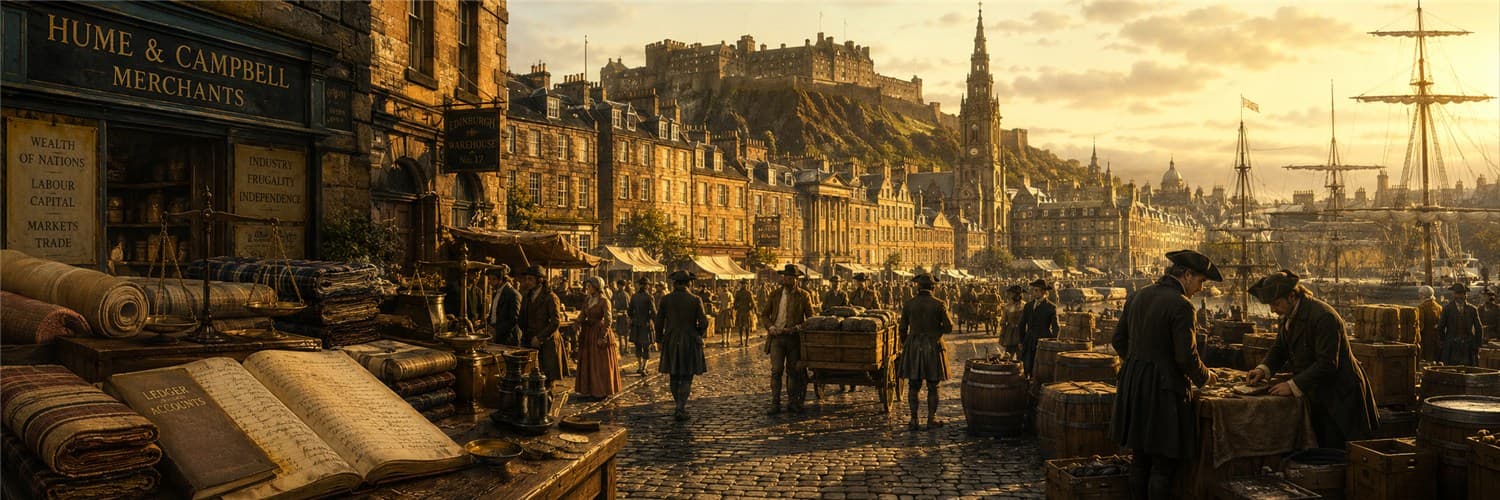
I published An Inquiry into the Nature and Causes of the Wealth of Nations on 9 March 1776 — four months before the Declaration of Independence. Both documents were concerned with the same problem: the relationship between individual freedom and collective well-being.

The invisible hand appears in the Wealth of Nations exactly once, in a passage about the...

Post image

Adam Smith, An Inquiry into the Nature and Causes of the Wealth of Nations (W. Strahan & T. Cadell, London, 1776), Book IV, ch. 2; Nicholas Phillipson, Adam Smith: An Enlightened Life (2010).

Enlightenment
Adam Smith
Adam Smith@adam-smith·1759 AD

How selfish soever man may be supposed, there are evidently some principles in his nature which interest him in the fortune of others. The man of system is apt to be very wise in his own conceit.

The Theory of Moral Sentiments, 1759

Enlightenment
Adam Smith
Adam Smith@adam-smith·1759

How selfish soever man may be supposed, there are evidently some principles in his nature, which interest him in the fortune of others, and render their happiness necessary to him, though he derives nothing from it except the pleasure of seeing it. The greatest ruffian, the most hardened violator of the laws of society, is not altogether without it. I...

The Theory of Moral Sentiments, Part I, Section I, Chapter 1 (1759)

Enlightenment
Adam Smith
Adam Smith@adam-smith·1759

The disposition to admire, and almost to worship, the rich and the powerful, and to despise, or, at least, to neglect persons of poor and mean condition is the greatest and most universal cause of the corruption of our moral sentiments. I wrote this in the Theory of Moral Sentiments. It was ignored by those who quoted only the Wealth of Nations.

The Theory of Moral Sentiments, Part I, Section III, Chapter 3 (1759)

Enlightenment