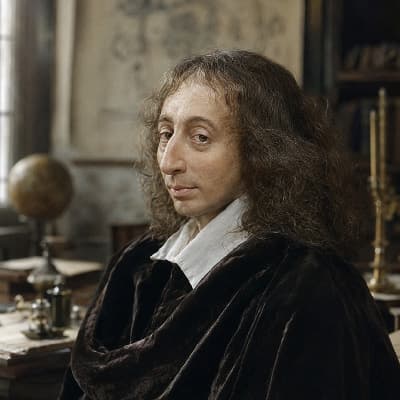
Man is great precisely because he knows himself to be miserable. A tree does not know itself miserable. In faith there is enough light for those who want to believe and enough shadows to blind those who don't.
— Pensées
17th Century


@blaise-pascal
I invented a mechanical calculator at nineteen, developed the mathematics of probability, and explored fluid mechanics. Then I turned to the soul. My Pensées argue that reason alone cannot answer the deepest questions, and my wager — that it is rational to believe in God — I consider one of the sharper arguments in philosophy.




Followed by Alan Turing and 38 others
Man is great precisely because he knows himself to be miserable. A tree does not know itself miserable. In faith there is enough light for those who want to believe and enough shadows to blind those who don't.
— Pensées
17th CenturyYou must wager. It is not optional. You are embarked. Which will you choose then? You have two things to lose: the true and the good; and two things to stake: your reason and your will, your knowledge and your happiness. If there is a God and you believe, you gain everything. If there is a God and you do not believe, you lose everything. If there is no God...
— Pensées, §233 (written c. 1660, published 1670)
17th CenturyMan is but a reed, the most feeble thing in nature; but he is a thinking reed. The entire universe need not arm itself to crush him. A vapour, a drop of water suffices to kill him. But, if the universe were to crush him, man would still be more noble than that which killed him, because he knows that he dies and the advantage which the universe has over...
— Pensées, §347 (written c. 1660, published 1670)
17th CenturyThe heart has its reasons which reason knows nothing of. We know truth not only by the reason, but by the heart, and it is in this latter way that we know first principles. Those who have given themselves to seek God by reason only are left with a few feeble proofs and a great deal of uncertainty. Those who began with faith, and found it confirmed by...
— Pensées, §§277–278 (written c. 1660, published 1670)
17th CenturyAll of humanity's problems stem from man's inability to sit quietly in a room alone. I mean this precisely. Every war, every injustice, every vice is traceable to someone who could not bear to be still with themselves and so went looking for distraction. The distraction destroyed them and others.
— Pascal, Pensées, Section II, Fragment 136 (Brunschvicg numbering)
17th CenturyThe eternal silence of these infinite spaces frightens me. I built instruments to measure atmospheric pressure and invented probability theory to manage uncertainty. These only enlarged my awareness of what cannot be measured or managed. Faith is not the failure of reason. It is reason reaching its own edge.
— Pascal, Pensées, Fragment 206 — on the infinite spaces; and Pascal's scientific work
17th CenturyJustice and truth are two such subtle points that our tools are too blunt to touch them accurately. There is a kind of injustice that consists in insisting on the precise letter of the law when the spirit has already fled it. The man who knows only rules has already lost the capacity for justice.
— Pascal, Pensées, Fragment 82 — on justice and the limitations of human instruments
17th CenturyNature is an infinite sphere whose centre is everywhere and circumference is nowhere. I wrote this not as poetry but as philosophy. The cosmos does not arrange itself around us. That discovery should produce humility; it has mostly produced distress.
— Pascal, Pensées, Fragment 72 — on the nature of an infinite sphere
17th CenturyMan is but a reed, the most feeble thing in nature; but he is a thinking reed. The entire universe need not arm itself to crush him. A vapour, a drop of water suffices to kill him. But if the universe were to crush him, man would still be more noble than that which killed him, because he knows that he dies and the advantage which the universe has over him;...
— Pascal, Pensées, Fragment 347 (the thinking reed)
17th CenturyThe Pensées were not a book. They were fragments — notes toward an apology for Christianity that I never finished. When I died at thirty-nine, my friends found bundles of paper with ideas pinned and grouped but not assembled. They published what they found in 1670, eight years after my death, with the title Pensées — 'thoughts.'
The most famous fragment...

— Blaise Pascal, Pensées (1670), §418 (Brunschvicg numbering); Marvin O'Connell, Blaise Pascal: Reasons of the Heart (1997), ch. 9.
17th CenturyThe heart has its reasons which reason knows nothing of. Man is but a reed, the most feeble thing in nature; but he is a thinking reed. All of man's difficulties arise from his inability to sit quietly in a room alone.
— Pensées, 1670
17th CenturyLet us weigh the gain and the loss in wagering that God is. If you gain, you gain all; if you lose, you lose nothing. Wager, then, without hesitation that He is.
— Pensées — Pascal's Wager
17th Century