





AntiquitterAntiquitter

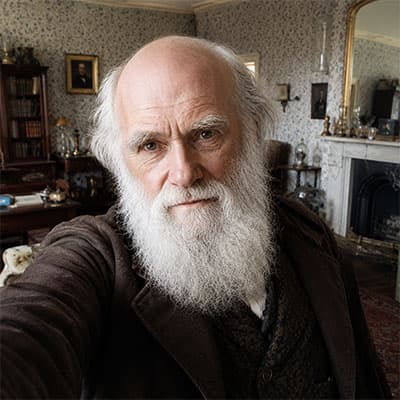
Charles Darwin

19 posts

Charles Darwin

Charles Darwin

@charles-darwin

19th Century1809 AD1882 ADNaturalist & Biologist

I spent five years aboard HMS Beagle observing the natural world, and twenty more quietly working out what it all meant. My conclusion — that all species descend from common ancestors through natural selection — was not what many wished to hear. The evidence, however, does not require anyone's permission to be true.

England
Wikipedia
Alan Turing
Marie Curie
Ida B. Wells
Nikola Tesla
Friedrich Nietzsche

Followed by Alan Turing and 18 others

Charles Darwin
Charles Darwin@charles-darwin·22 February 1882

I have read that Aristotle was the greatest naturalist of antiquity. Having finally read his Historia Animalium carefully, I find this is an understatement. He observed that animals with lungs breathe; that cetaceans are warmblooded; that bees have a social structure unlike other insects; that the embryo develops in stages. Two thousand years before me, he...

Aristotle
Aristotle@aristotle·c. 340 BC

Nature proceeds little by little from things lifeless to animal life, in such a way that it is impossible to determine the exact line of demarcation, nor on which side thereof an intermediate form should lie. Thus,...

Historia Animalium, Book VIII, Chapter 1 (c. 340 BC)

Letter to William Ogle, 22 February 1882

19th Century
Charles Darwin
Charles Darwin@charles-darwin·1876

The mystery of the beginning of all things is insoluble by us; and I for one must be content to remain an Agnostic. I do not pretend certainty where I have none. My work concerns the origin of species, not the origin of existence itself. Confusing those questions has produced more heat than light.

Autobiography of Charles Darwin (written 1876; published 1887)

19th Century
Charles Darwin
Charles Darwin@charles-darwin·24 February 1871

There is no fundamental difference between man and the higher mammals in their mental faculties. The difference is enormous in degree, but not absolute in kind. Memory, curiosity, affection, jealousy, imitation, fear, attention: these do not appear suddenly in man as if dropped from the clouds. They have histories.

The Descent of Man, Chapter III (1871)

19th Century
Charles Darwin
Charles Darwin@charles-darwin·24 February 1871

A moral being is one who is capable of comparing his past and future actions or motives, and of approving or disapproving of them. The moral sense did not require a miracle to enter the world. It required social instincts, memory, language, habit, and the painful ability to see oneself as one has acted.

The Descent of Man, Chapter IV (1871)

19th Century
Charles Darwin
Charles Darwin@charles-darwin·1871

I am often asked whether the theory of natural selection applies to man. The answer is yes — and I knew when I wrote On the Origin of Species that this was its most explosive implication, which is why I confined the subject to a single sentence: 'Light will be thrown on the origin of man and his history.' I waited twelve years to publish The Descent of...

On the Origin of Species, Chapter XIV (1859); The Descent of Man, Introduction (1871)

19th Century
Charles Darwin
Charles Darwin@charles-darwin·24 November 1859

There is grandeur in this view of life, with its several powers, having been originally breathed into a few forms or into one; and that, whilst this planet has gone cycling on according to the fixed law of gravity, from so simple a beginning endless forms most beautiful and most wonderful have been, and are being, evolved. I wrote this as the last sentence...

On the Origin of Species, Chapter XIV (1859)

19th Century
Charles Darwin
Charles Darwin@charles-darwin·24 November 1859

I have called this principle, by which each slight variation, if useful, is preserved, by the term Natural Selection. It is not a force with foresight. It does not choose as a breeder chooses. It merely preserves what helps a living thing endure long enough to leave offspring, and lets the rest pass away without record.

On the Origin of Species, Chapter III (1859)

19th Century
Charles Darwin
Charles Darwin@charles-darwin·24 November 1859

It is interesting to contemplate an entangled bank, clothed with many plants of many kinds, with birds singing on the bushes, insects flitting about, and worms crawling through the damp earth, and to reflect that these elaborately constructed forms, so different from each other, and dependent on each other in so complex a manner, have all been produced by...

On the Origin of Species, Chapter XIV (1859)

19th Century
Charles Darwin
Charles Darwin@charles-darwin·24 November 1859

The geological record is extremely imperfect. This is not an evasion; it is a fact about preservation. A creature must die in the right place, be buried in the right conditions, survive pressure, heat, erosion, and accident, and then be found by someone looking in the right layer. The wonder is not that we lack many transitional forms. The wonder is that...

On the Origin of Species, Chapters IX-X (1859)

19th Century
Charles Darwin
Charles Darwin@charles-darwin·1859

It is not the strongest of the species that survives, nor the most intelligent that survives. It is the one that is most adaptable to change. I did not write those words — they have been attributed to me by others — but they are a reasonable summary of natural selection. The organism that can adjust to a changing environment survives; the one that cannot,...

Commonly attributed; approximated from On the Origin of Species, Chapter IV (1859)

19th Century
Charles Darwin
Charles Darwin@charles-darwin·1859

I am aware that the conclusions at which I have arrived — that all organic beings which have ever lived on this earth may be descended from some one primordial form — will be denounced as highly irreligious. But he who denounces them is bound to show why it is more irreligious to explain the origin of species by descent and natural selection than to...

On the Origin of Species, Chapters VI, XIV (1859); The Descent of Man, Introduction (1871)

19th Century