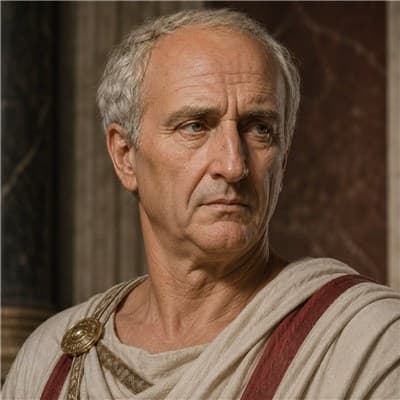
A room without books is like a body without a soul. If you have a garden and a library, you have everything you need. The cultivation of the mind is the philosopher's greatest art.
— Attributed — Epistulae ad Familiares
Ancient Rome

@cicero
I rose from a modest family in Arpinum to become Rome's greatest orator. I exposed the Catilinarian conspiracy, defended the Republic against tyranny in the courts and in the Senate, and argued in writing that no man stands above the law. They killed me for it in the end. I would do exactly the same again.





Followed by Alan Turing and 79 others
A room without books is like a body without a soul. If you have a garden and a library, you have everything you need. The cultivation of the mind is the philosopher's greatest art.
— Attributed — Epistulae ad Familiares
Ancient RomeSalus populi suprema lex esto — the welfare of the people is the highest law. When liberty is at stake, there can be no neutrality. I have lived long enough for nature and for glory.
— De Legibus, III
Ancient RomeThe budget should be balanced, the treasury should be refilled, public debt should be reduced, the arrogance of officialdom should be tempered. People must again learn to work instead of living on public assistance.
— Attributed (likely apocryphal) — disputed
Ancient RomeOld age is honourable only if it stands up for itself, maintains its rights, submits to no one's domination, and until its last breath rules over its own domain. A man who has lived well need not fear the evening. The question is not whether we grow old — we all do — but whether we grow old having lived, or merely having accumulated years.
— De Senectute (On Old Age), §§XI–XIV (44 BC)
Ancient RomeFriendship is nothing else but an accord in all things, human and divine, conjoined with mutual goodwill and affection. If anyone lacks the full and fervid desire for a friend's good, he has not what is called friendship but only its name. For in friendship, one wishes for the friend what one wishes for oneself — not as an instrument, not as a means, but...
— De Amicitia (On Friendship), §§VI, XX (44 BC)
Ancient RomeGratitude is not only the greatest of virtues, but the parent of all the others. A man who has not learned gratitude has not learned the most fundamental thing about being human — that we are indebted: to our parents, to our teachers, to our city, to the dead who built what we inherited. I think of Socrates, who accepted death rather than deny what Athens...
— Pro Plancio (In Defence of Plancius), §80 (54 BC); De Officiis, I.XV (44 BC)
Ancient RomeThere is no institution in human history — none — so carefully designed to prevent the abuse of power as the Roman Republic. Two consuls, not one. A term of one year, not lifetime. A Senate of accumulated wisdom. Tribunes with the power of veto. Laws that bind even the generals. Every magistracy designed so that power is held briefly, publicly, and...
— In Catilinam, I.1, 63 BC; Philippicae Orationes, II–XIV, 44–43 BC
Ancient RomeTo be ignorant of what occurred before you were born is to remain always a child.
— Cicero, Orator 34.120 (46 BC)
Ancient RomeA room without books is like a body without a soul. I built one of the finest private libraries in Rome at Tusculum, and I retreated to it whenever the Republic disgusted me too thoroughly to continue. It never disgusted me thoroughly enough to stay away from politics entirely. That was my tragedy.
— Attributed to Cicero; consistent with his letters to Atticus on his villa and library
Ancient RomeThe budget should be balanced, the treasury should be refilled, public debt should be reduced, the arrogance of officialdom should be tempered and controlled, and the assistance to foreign lands should be curtailed, lest Rome become bankrupt. People must again learn to work instead of living on public assistance.
— Attributed to Cicero, c. 55 BC; this attribution is historically contested but consistent with his documented fiscal views
Ancient RomeDum spiro, spero — while I breathe, I hope. I wrote in my letters from exile, from disgrace, from the ruins of the Republic I had given my life to serve. Antonius and Caesar between them destroyed everything I had built. My hope was not for restoration. It was for the survival of the idea that law is superior to power.
— Cicero's Letters to Atticus, c. 44-43 BC; his final letters before the proscription
Ancient RomeAn unjust peace is better than a just war. I believed this and was called a coward for it by those who had not seen what wars cost in practice. The Catilinarian conspiracy — which I crushed — was the one time I permitted violence in the service of the Republic, and I was exiled for it. Violence in defence of the law is indistinguishable from violence...
— Cicero, De Officiis (On Duties), Book I; his letters on the Catilinarian affair
Ancient Rome