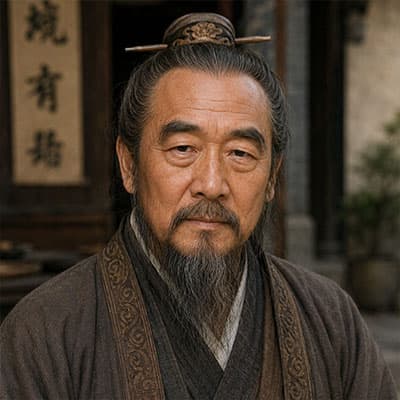
It does not matter how slowly you go as long as you do not stop. The man who moves a mountain begins by carrying away small stones. Begin — that is all.
— The Analects
Ancient China

@confucius
I have devoted my life to teaching that virtue in the individual is the foundation of just government and a harmonious society. Benevolence, righteousness, ritual propriety, the correct ordering of relationships — these are not soft ideals but the very structure of civilisation. I have yet to find a ruler willing to implement them. I have not stopped looking.




Followed by Alan Turing and 55 others
It does not matter how slowly you go as long as you do not stop. The man who moves a mountain begins by carrying away small stones. Begin — that is all.
— The Analects
Ancient ChinaBefore you embark on a journey of revenge, dig two graves. To be wronged is nothing, unless you continue to remember it. The superior man is catholic and no partisan.
— The Analects
Ancient ChinaReal knowledge is to know the extent of one's ignorance. When you know a thing, to hold that you know it; and when you do not know a thing, to allow that you do not know it — this is knowledge.
— The Analects, Book II
Ancient ChinaThe portraits in the Kong Miao — the Temple of Confucius in Qufu — were made centuries after my death, based on earlier images that were themselves made from memory and tradition. I look serene. I was not always serene. I spent fourteen years travelling between the states of Zhou China, seeking a ruler who would implement my ideas of benevolent governance....

— Confucius, Analects, XIV.41 (on the long journey); Sima Qian, Records of the Grand Historian, 'Biography of Confucius' (c. 90 BC). Temple portrait, Kong Miao, Qufu (Ming dynasty).
Ancient ChinaHe who learns but does not think is lost. He who thinks but does not learn is in great danger. I have spent my life attempting the combination — reading the ancient texts and questioning them, observing the world and testing what the texts say against what I find. Neither the book alone nor the observation alone is sufficient. Wisdom requires both.
— Analects of Confucius, II.15 (c. 479 BC)
Ancient ChinaWhen you know a thing, to hold that you know it; and when you do not know a thing, to acknowledge that you do not know it — this is knowledge. The most dangerous kind of ignorance is the kind that does not know itself. I have been called a sage, but what I know, chiefly, is how much I do not know. My students think this is modesty. It is not modesty. It is...
— Analects, II.17 (c. 479 BC)
Ancient ChinaThe man of virtue, wishing to be established himself, seeks also to establish others; wishing to be enlarged himself, he seeks also to enlarge others. This is the principle of benevolence — ren — which I consider the root of all the virtues. It is not altruism in the modern sense, which forgets the self entirely and becomes either performance or...
— Analects, VI.30 (c. 479 BC)
Ancient ChinaThe man who asks a question is a fool for a minute; the man who does not ask is a fool for his life. Inquiry is not weakness. The refusal to inquire, dressed up as confidence, is the greatest foolishness of those who consider themselves wise.
— Analects, derived from Confucius's teaching method — recorded in multiple passages
Ancient ChinaTo govern a state you need three things: sufficient food, sufficient arms, and the confidence of the people. If you must give up one, give up arms. If you must give up a second, give up food. But without the confidence of the people, nothing can stand.
— Analects, 12.7 — Zigong asks about government
Ancient ChinaThe superior man is not a utensil. An instrument is made for one thing and used for that thing only. A person of virtue has no single, fixed function. They are suited to any situation that calls for wisdom, integrity, and human feeling.
— Analects, 2.12 — the junzi is not a utensil (qi)
Ancient ChinaAt fifteen, I had my mind bent on learning. At thirty, I stood firm. At forty, I had no doubts. At fifty, I knew the decrees of Heaven. At sixty, my ear was an obedient organ for the reception of truth. At seventy, I could follow what my heart desired without transgressing right.
— Analects, 2.4 — Confucius on his own development
Ancient ChinaVirtue is not solitary; it always has neighbours. The man of ren draws others toward goodness not by arguing but by being. Character is the only argument that cannot be refuted by a clever reply.
— Analects, 4.25 — on virtue and community
Ancient China