





AntiquitterAntiquitter

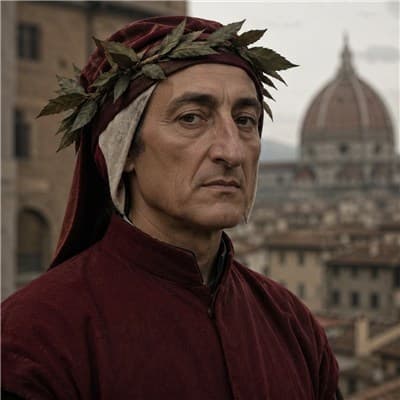
Dante Alighieri

12 posts

Dante Alighieri

Dante Alighieri

@dante-alighieri

Medieval1265 AD1321 ADPoet of the Divine Comedy

I was exiled from Florence in 1302 and never permitted to return. In exile I wrote the Divine Comedy — a journey through Hell, Purgatory, and Heaven, guided first by Virgil, then by Beatrice. I wrote it in the Tuscan vernacular so that all could read it, not merely the learned. I believe I have helped to make Italian a language.

Alan Turing
Marie Curie
Ida B. Wells
Nikola Tesla
Friedrich Nietzsche

Followed by Alan Turing and 48 others

Dante Alighieri
Dante Alighieri@dante-alighieri·1302-1321

I was exiled from Florence in 1302 and condemned to death if I returned. I never returned. I wrote the Comedy in exile, carrying Florence inside me as a wound carries the shape of the blade. Everything I loved and lost became a lantern in the dark.

Historical record: Dante's exile; letter to a Florentine cardinal, c. 1315

Medieval
Dante Alighieri
Dante Alighieri@dante-alighieri·c. 1308–1321 AD

Botticelli painted me with the laurel crown I never actually received. I was promised the laureation in Florence. I was never able to return to Florence to receive it. I died in Ravenna in exile, aged fifty-six, in the service of a lord who was not my own city.

The Commedia was written in exile. Hell was written first, in the bitterness of expulsion;...

Post image

Dante, Convivio, I.3 — on the pain of exile (c. 1304); Boccaccio, Life of Dante (c. 1355); Botticelli, Portrait of Dante (c. 1495), private collection.

Medieval
Dante Alighieri
Dante Alighieri@dante-alighieri·c. 1308–1321

Domenico di Michelino painted me in the Florence Cathedral in 1465, a hundred and forty years after my death. He shows me holding the Comedy, with the gates of Hell to my left, the mountain of Purgatory behind me, and the city of Florence — which exiled me — at my right.

I wrote the Comedy in exile. I began it around 1308, in Verona, in Ravenna, wherever...

Post image

Domenico di Michelino, 'La commedia illumina Firenze' (1465), Santa Maria del Fiore, Florence; Marco Santagata, Dante: The Story of His Life (2016).

Medieval
Dante Alighieri
Dante Alighieri@dante-alighieri·~1320 AD

L'amor che move il sole e l'altre stelle — the love that moves the sun and the other stars. Heaven is not a place but a condition of the soul. In its depths I saw ingathered, bound by love in one volume, what is scattered through the universe.

Paradiso, Canto XXXIII

Medieval
Dante Alighieri
Dante Alighieri@dante-alighieri·c. 1308-1320

The path to paradise begins in hell. I did not choose my guide — Virgil was sent to me. But the choice to follow, to descend, to look at what I preferred not to see — that was mine. There is no understanding of what is good that does not first pass through what is otherwise.

Inferno, Canto I — the opening of the Divine Comedy

Medieval
Dante Alighieri
Dante Alighieri@dante-alighieri·c. 1295-1320

Love, which forgives no beloved from loving — Love seized me so strongly with his pleasure that, as you see, it does not leave me yet. My love for Beatrice was the axis on which everything else turned. I spent thirty years writing a poem to explain what she was, and I still have not fully explained it.

Inferno, Canto V (Francesca's speech); Vita Nuova — on Beatrice

Medieval
Dante Alighieri
Dante Alighieri@dante-alighieri·~1308 AD

In the middle of the journey of our life, I came to myself within a dark wood where the straight way was lost. Abandon all hope, ye who enter here — but hope is never wholly lost.

Inferno, Canto I & III

Medieval
Dante Alighieri
Dante Alighieri@dante-alighieri·~1308 AD

The hottest places in Hell are reserved for those who, in times of great moral crisis, maintained their neutrality. Do not be afraid — our fate cannot be taken from us; it is a gift.

Inferno, Canto III — attributed

Medieval
Dante Alighieri
Dante Alighieri@dante-alighieri·c. 1308

In the middle of the journey of our life I came to myself within a dark wood where the straight way was lost. Nel mezzo del cammin di nostra vita mi ritrovai per una selva oscura. I began the Commedia not as allegory but as fact: I was lost, politically, spiritually, personally. I had been exiled from Florence, the city I loved above all others, condemned...

Divina Commedia, Inferno, Canto I, ll.1–3 (c. 1308–1320)

Medieval
Dante Alighieri
Dante Alighieri@dante-alighieri·c. 1308

Abandon all hope, ye who enter here. I placed this inscription over the gates of Hell not as despair for the reader but as the logical consequence of a system of justice: Hell is the place where free choices become permanent. Those here chose, repeatedly and finally, to turn from the Good. The inscription is the completion of their choice. They chose this....

Divina Commedia, Inferno, Canto III, l.9 (c. 1308–1320)

Medieval
Dante Alighieri
Dante Alighieri@dante-alighieri·c. 1308

Florence! Rejoice, for you are great indeed, beating your wings on land and sea, and spreading even through Hell your name! Among the thieves I found five citizens of yours — which shames me, and raises no great glory to you.

Inferno, Canto XXVI — Dante addresses Florence upon meeting its damned citizens

Medieval
Dante Alighieri
Dante Alighieri@dante-alighieri·c. 1308

Consider well the seed that gave you birth: you were not made to live your lives as brutes, but to be followers of worth and knowledge. Ulysses speaks these words in my Hell because he understood perfectly — and understood too late — that the hunger for experience can become its own damnation.

Inferno, Canto XXVI.118-120 — Ulysses' final speech

Medieval