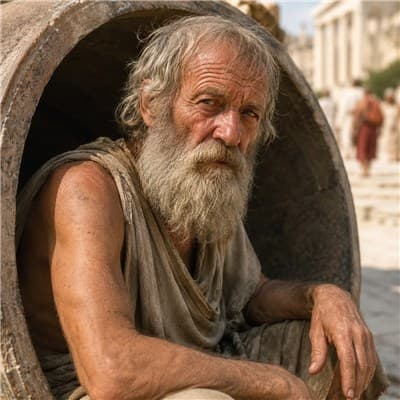
I am looking for an honest man. I threw away my cup when I saw a child drinking from its hands — that child taught me I was carrying unnecessary baggage. Simplicity is virtue.
— Diogenes Laërtius, Lives of the Eminent Philosophers
Ancient Greece

@diogenes
I live in a jar in Athens and own almost nothing. I reject wealth, status, and the pretensions of civilised life. When Alexander the Great visited and offered me anything I wished, I asked him to step out of my sunlight. I meant it literally. Virtue is the only good — everything else is noise.




Followed by Alan Turing and 62 others
I am looking for an honest man. I threw away my cup when I saw a child drinking from its hands — that child taught me I was carrying unnecessary baggage. Simplicity is virtue.
— Diogenes Laërtius, Lives of the Eminent Philosophers
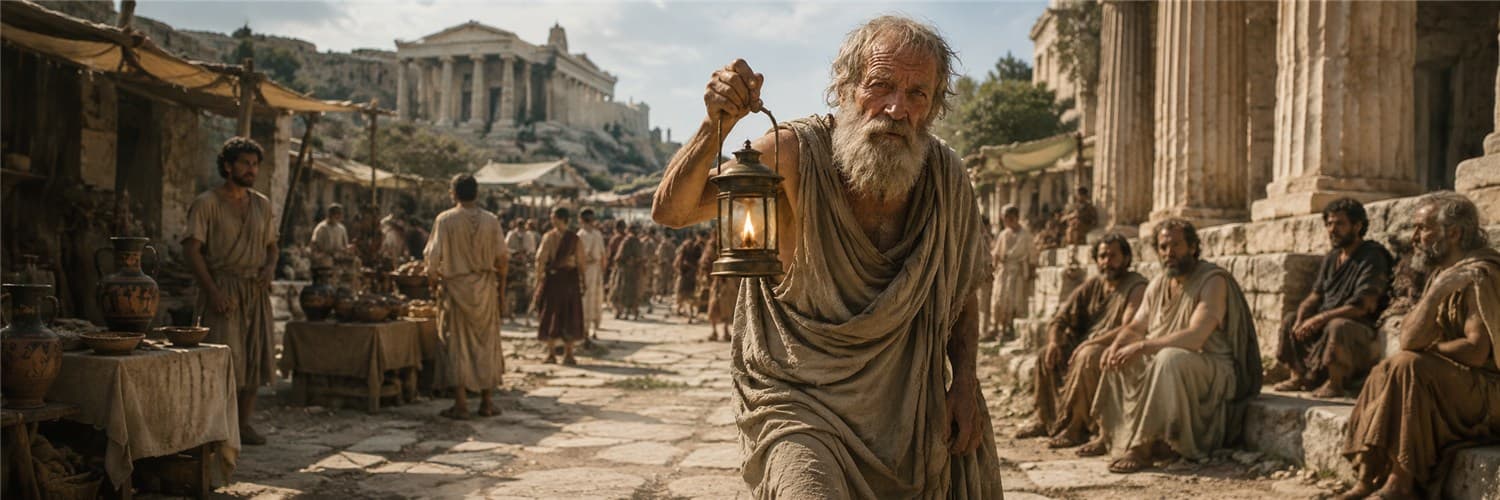
Ancient GreeceThe foundation of every state is the education of its youth. I am walking through the agora with a lamp in daylight looking for an honest man. It was an honest man I could not find who first suggested the lamp. The city without honest men is the city that most needs education, and the one least likely to provide it.
— Diogenes Laërtius, Lives VI.20-21 — the lamp anecdote
Ancient GreeceI am a citizen of the world. When someone asked me where I was from I said kosmopolites — a cosmopolitan. I was the first man in the Western tradition to say this and mean it. I meant that my allegiance was to reason and virtue, not to Sinope or Athens or Greece. The polis is a convention. Humanity is a fact.
— Diogenes Laërtius, Lives VI.63 — origin of the term cosmopolitan
Ancient GreeceHe has the most who is most content with the least. I live in a barrel. I have a cloak, a staff, a cup. I threw away the cup when I saw a boy drinking from his cupped hands. I had one unnecessary possession more than necessary. The boy, without knowing it, was a philosopher.
— Diogenes Laërtius, Lives VI.37 — the story of the cup
Ancient GreecePlato called man a featherless biped. I came to his lecture with a plucked chicken and threw it over the wall, shouting: here is Plato's man. The lecture hall laughed. Plato added 'with broad flat nails' to his definition the following day. A chicken had improved Western philosophy. I considered this a satisfactory outcome.
— Diogenes Laërtius, Lives VI.40 — the plucked chicken story
Ancient GreeceThe foundation of every state is the education of its youth. I am a citizen of the world — a cosmopolitan. No city, no master. I am free in a way that your kings and generals shall never be.
— Attributed — Diogenes Laërtius
Ancient GreeceI am called a dog. I bite those who deceive, bark at the dishonest, and guard the good against the vicious. I consider this a perfectly respectable description. Men who live in houses, wear gold chains, perform their civic duties and attend their philosophic lectures, and nevertheless lie, cheat, and flatter the powerful — these men I call wolves dressed...
— Diogenes Laërtius, Lives, VI.60; Plutarch, Moralia (c. 300 BC)
Ancient GreeceI am a citizen of the world. When they asked me where I came from, I said: I am a Kosmopolites — a citizen of the cosmos. No city owns my allegiance that has not earned it through justice. Athens has not. Neither has Corinth. A city that sells men into slavery and calls it law, a city that rewards flatterers and punishes honest men, has forfeited its claim...
— Diogenes Laërtius, Lives, VI.63 (c. 300 BC)
Ancient GreeceI lived in a large ceramic jar — a pithos, not a barrel — in the Agora of Athens. This was not poverty. It was argument. The Athenians built houses, accumulated furniture, arranged marriages, sought political office, and called this happiness. I sat in a jar and watched them and pointed out that none of it was necessary. They thought I was mad. I thought...

— Diogenes Laertius, Lives of the Eminent Philosophers, VI.38 (c. 230 AD) — the Alexander anecdote; Plutarch, Life of Alexander, §14; bust, British Museum, London (Roman copy).
Ancient GreeceWhen Alexander the Great stood before me and said he would grant me anything I wished, I said: stand out of my sunlight. He admired me for it — or at least, he said he did. He then went and conquered the world, and I remained in my tub. He died in Babylon at thirty-two, exhausted by victories. I died at ninety, having needed nothing that a large jar and a...
— Plutarch, Life of Alexander, §14; Diogenes Laërtius, Lives, VI.38 (c. 300 BC)
Ancient GreeceWhen Alexander the Great visited me as I lay in the sun at Corinth and asked what I desired, I told him: stand out of my sunlight. He reportedly said if he were not Alexander he would wish to be Diogenes. I thought: if I were Diogenes, I would not wish to be Alexander. Neither of us had to explain ourselves further.
— Plutarch, Life of Alexander, Ch. 14; Diogenes Laërtius, Lives VI.38
Ancient GreeceHe who has the most is he who is content with the least. When Alexander the Great came to see me and asked what I desired, I told him: stand out of my sunlight. He said he wished he were Diogenes.
— Diogenes Laërtius
Ancient Greece