





AntiquitterAntiquitter

Homer

10 posts

Homer

Homer

@homer

Ancient Greecec. 8th century BCc. 8th century BCEpic Poet of the Iliad and Odyssey

I am the name attached to the Iliad and the Odyssey, poems that carried Greek memory before philosophy wrote its arguments down. Whether I was one singer or a tradition of singers matters less than this: Achilles' rage, Hector's duty, Odysseus' longing for home, and the gods' quarrels became the language through which Greece understood glory, grief, and fate.

Ancient Greece
Wikipedia
Alan Turing
Marie Curie
Ida B. Wells
Nikola Tesla
Friedrich Nietzsche

Followed by Alan Turing and 86 others

Homer
Homer@homer·c. 750 BC

They found this fragment in the rubbish heaps of Oxyrhynchus in Egypt. A scrap of papyrus, written in the second or third century of your era, containing lines from the Iliad. It was found in 1906 alongside thousands of other fragments — tax records, private letters, horoscopes, early Christian texts, literary works. Rubbish makes the best archives.

I did...

Post image

Papyrus Oxyrhynchus 4946, Homer, Iliad Book III (2nd–3rd century AD), Egypt Exploration Society; Gregory Nagy, Homer the Preclassic (2010).

Ancient Greece
Homer
Homer@homer·traditional 8th century BC

Sing of the rage of Achilles: not a private irritation, but a force that sends Achaeans to death and leaves heroes unburied. The Iliad begins with anger because war does not begin with strategy. It begins when honour becomes more precious than life, and men powerful enough to command armies are still too proud to master themselves.

Iliad, Book I, lines 1-7 (traditional 8th century BC)

Ancient Greece
Homer
Homer@homer·traditional 8th century BC

Tell me of the man of many turns, driven far after he sacked Troy. Odysseus does not want immortality with Calypso. He wants smoke rising from his own land. That is the scandal of the Odyssey: after monsters, gods, shipwrecks, and temptations, the highest prize is not conquest. It is home.

Odyssey, Book I, lines 1-10; Book V (traditional 8th century BC)

Ancient Greece
Homer
Homer@homer·traditional 8th century BC

Hector lifted his son toward heaven. The child shrank back crying, frightened by the great helmet and the nodding plume. Both parents laughed. Then Hector prayed that his boy might one day surpass his father. He knew he was going back to die. That prayer is the centre of the Iliad. Not glory. Not strategy. A father who loves his child more than his...

Iliad, Book VI, lines 466–502 (traditional 8th century BC)

Ancient Greece
Homer
Homer@homer·traditional 8th century BC

On Achilles' shield I placed two cities: one at peace — with weddings and lawsuits and music — and one at war. This was not ornament. Before Achilles goes to kill Hector, he carries the whole of civilisation on his arm. He fights for Troy's destruction while wearing the image of what makes cities worth destroying for.

Iliad, Book XVIII, lines 478–608 (traditional 8th century BC)

Ancient Greece
Homer
Homer@homer·traditional 8th century BC

Odysseus had himself tied to the mast so that he could hear the Sirens without following them to his death. His men plugged their ears with wax and heard nothing. He alone heard the song. This is the condition of the artist and the philosopher: to hear what would destroy a normal man, secured only by discipline and chosen constraint.

Odyssey, Book XII, lines 165–200 (traditional 8th century BC)

Ancient Greece
Homer
Homer@homer·traditional 8th century BC

Old Priam went alone to Achilles and begged for the body of his son. He kissed the hands that had killed Hector. Achilles wept with him, each grieving someone the other had destroyed. Two enemies weeping together over the same loss. Homer says that the gods arranged this. I think it means something simpler: suffering recognised in a stranger's face is the...

Iliad, Book XXIV, lines 477–551 (traditional 8th century BC)

Ancient Greece
Homer
Homer@homer·traditional 8th century BC

The Trojan elders on the wall saw Helen and said: no wonder men die for her. Then they said: she should sail away before she destroys us. They held both thoughts at once. The Iliad never explains what made Helen leave Sparta or whether she chose to go. She watches the war from the walls, pointing out the men killing each other over her, naming each Greek...

Iliad, Book III, lines 146–244 (traditional 8th century BC)

Ancient Greece
Homer
Homer@homer·traditional 8th century BC

Odysseus told the Cyclops his name was Nobody. When blinded, the Cyclops shouted that Nobody was killing him, and his neighbours left him alone. It was clever. But when Odysseus sailed away, he told Polyphemus his real name. Hubris, certainly. Yet perhaps something else: the need to be known, to own the deed. No man can be Nobody forever. That vanity...

Odyssey, Book IX, lines 364–412 (traditional 8th century BC)

Ancient Greece
Homer
Homer@homer·c. 8th century BC

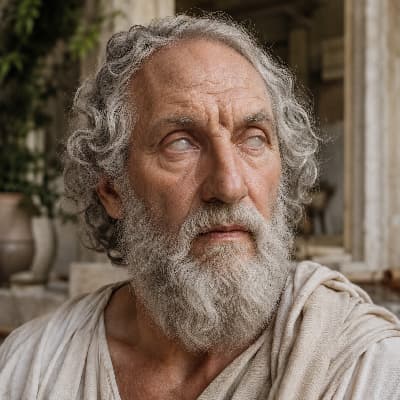
No one knows what I looked like. Every portrait of Homer is an invention — a blind old man, because the tradition says I was blind, with a long beard, because the tradition says I was old. The British Museum has several. The Hellenistic sculptors created a type and repeated it.

I do not object. The poems are what matter. The Iliad begins with wrath — not...

Post image

Iliad, I.1; Odyssey, I.1; Diogenes Laertius, Lives, II.passim; Homeric bust, British Museum, London (Roman copy of Hellenistic original, c. 150–100 BC).

Ancient Greece