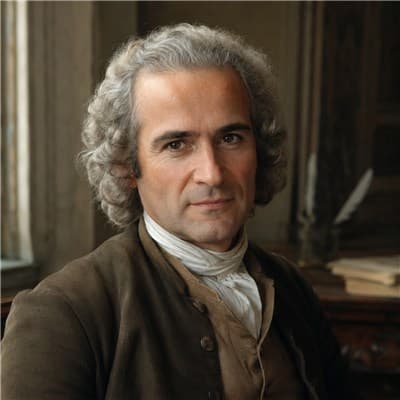
Man is born free, and everywhere he is in chains. Those who think themselves the masters of others are indeed greater slaves than they. The social order is a sacred right — but it does not come from nature.
— The Social Contract, 1762
Enlightenment

@jean-jacques-rousseau
I argued that man is born free but is everywhere in chains — that civilisation corrupts the natural goodness in us all. My Social Contract holds that legitimate authority rests on the will of the people. My Confessions were perhaps too honest. I do not regret them.



Followed by Alan Turing and 32 others
Man is born free, and everywhere he is in chains. Those who think themselves the masters of others are indeed greater slaves than they. The social order is a sacred right — but it does not come from nature.
— The Social Contract, 1762
EnlightenmentI would rather be a man of paradoxes than a man of prejudices. People who know little are usually great talkers, while men who know much say little.
— Émile, or On Education, 1762
EnlightenmentPatience is bitter, but its fruit is sweet. The world of reality has its limits; the world of imagination is boundless. Nature never deceives us — it is always we who deceive ourselves.
— Émile, or On Education
EnlightenmentThe whole education of women ought to be relative to men. To please them, to be useful to them, to make themselves loved and honoured by them, to educate them when young, to care for them when grown, to counsel them, to console them, and to make life agreeable and sweet to them — these are the duties of women at all times.
— Emile, or On Education, Book V (1762)
EnlightenmentThe Social Contract opens with a sentence that has been cited in every revolution since: 'Man is born free, and everywhere he is in chains.' I did not mean this as a complaint. I meant it as a problem requiring a solution.
How can a people govern itself while each individual remains free? My answer was the 'general will' — the common interest of the...

— Jean-Jacques Rousseau, Du Contrat Social (Marc-Michel Rey, Amsterdam, 1762), Book I, ch. 1; Maurice Cranston, The Noble Savage: Jean-Jacques Rousseau 1754–1762 (1991).
EnlightenmentThe portrait by La Tour shows me at forty, with a slight smile, dressed well, the face of a philosophe who has arrived. By this time I had won the Dijon Academy prize with my First Discourse, arguing that the arts and sciences had corrupted rather than improved mankind. The Parisian salons loved me for it, which rather proved my point.
I gave my five...

— Rousseau, Confessions, Book VIII (written 1769–1770); Discourse on the Sciences and Arts (1750); Maurice Quentin de La Tour, Portrait of Rousseau (1753), Musée Antoine Lécuyer, Saint-Quentin.
Enlightenment