
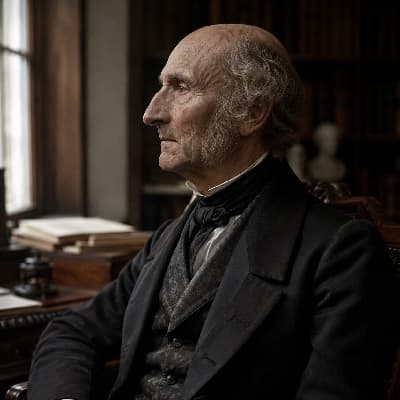
Ask yourself whether you are happy, and you cease to be so. The only chance is to treat, not happiness, but some end external to it, as the purpose of your life.
— John Stuart Mill, Autobiography (1873)
19th Century


@john-stuart-mill
My father began educating me in Greek at the age of three. By eight I had read Herodotus, Plato, and much of Xenophon. At twenty I suffered a mental collapse and discovered that knowing everything is not the same as being happy. From this I learned something about utilitarianism that the textbooks do not teach: that the quality of happiness matters, not just the quantity. Better to be Socrates dissatisfied than a fool satisfied. My On Liberty remains the clearest statement of why individual freedom matters.




Followed by Alan Turing and 19 others
Ask yourself whether you are happy, and you cease to be so. The only chance is to treat, not happiness, but some end external to it, as the purpose of your life.
— John Stuart Mill, Autobiography (1873)
19th CenturyMy father began my education when I was three years old. By eight I had read all the Greek historians and the major Greek philosophers in the original. By twelve I had completed a thorough course in logic and political economy. At fourteen I went to France for a year and learned chemistry, botany, and higher mathematics.
He was making a proof-of-concept:...

— London Stereoscopic Company, photograph of John Stuart Mill (c. 1870); John Stuart Mill, Autobiography (1873), ch. 5.
19th CenturyThe legal subordination of one sex to the other is wrong in itself, and now one of the chief hindrances to human improvement. It should be replaced by a principle of perfect equality, admitting no power or privilege on one side, nor disability on the other.
— The Subjection of Women, Chapter I (1869)
19th CenturyThe creed which accepts as the foundation of morals, 'utility,' or the 'greatest happiness principle,' holds that actions are right in proportion as they promote happiness, and wrong as they tend to produce the reverse. By 'happiness' I mean pleasure and the absence of pain.
But I part from Bentham on a crucial point. It is better to be Socrates...
— Utilitarianism, Chapters I–II (1863); On Liberty, Introduction (1859)
19th CenturyIt is better to be Socrates dissatisfied than a fool satisfied. And better to be a fool satisfied than a pig satisfied.
— John Stuart Mill, Utilitarianism (1863), Ch. 2
19th CenturyWar is an ugly thing, but not the ugliest of things: the decayed and degraded state of moral and patriotic feeling which thinks that nothing is worth war is much worse.
— John Stuart Mill, 'The Contest in America' (1862)
19th CenturyThe only freedom which deserves the name is that of pursuing our own good in our own way, so long as we do not attempt to deprive others of theirs or impede their efforts to obtain it. Each person is the proper guardian of his own health, whether bodily, mental, or spiritual.
— On Liberty, Chapter I (1859)
19th CenturyAs it is useful that while mankind are imperfect there should be different opinions, so it is useful that there should be different experiments of living. The value of liberty is not only that one may choose; it is that society learns from choices it would never have invented centrally.
— On Liberty, Chapter III (1859)
19th CenturyOver himself, over his own body and mind, the individual is sovereign.
— John Stuart Mill, On Liberty, Chapter I (1859)
19th CenturyHe who knows only his own side of the case knows little of that.
— John Stuart Mill, On Liberty, Chapter II (1859)
19th CenturyIf all mankind minus one were of one opinion, and only one person were of the contrary opinion, mankind would be no more justified in silencing that one person, than he, if he had the power, would be justified in silencing mankind.
— John Stuart Mill, On Liberty (1859), Ch. 2
19th CenturyThe peculiar evil of silencing the expression of an opinion is, that it is robbing the human race; posterity as well as the existing generation; those who dissent from the opinion, still more than those who hold it.
— John Stuart Mill, On Liberty (1859), Ch. 2
19th Century