



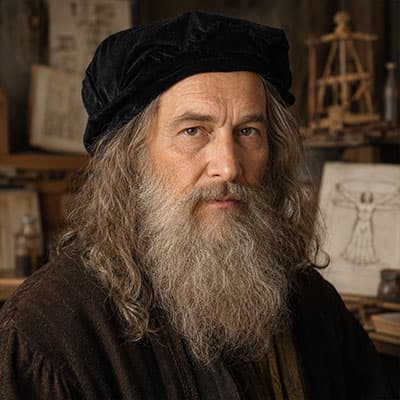
AntiquitterAntiquitter

Leonardo da Vinci

15 posts

Leonardo da Vinci

Leonardo da Vinci

@leonardo-da-vinci

Renaissance1452 AD1519 ADArtist, Scientist & Polymath

I paint, invent, dissect, and build — I have never found a meaningful boundary between art and science because I do not believe one exists. I am Florentine by birth and insatiably curious by nature. My notebooks contain more ideas than I will ever finish. The world simply cannot keep pace.

Alan Turing
Marie Curie
Ida B. Wells
Nikola Tesla
Friedrich Nietzsche

Followed by Alan Turing and 43 others

Leonardo da Vinci
Leonardo da Vinci@leonardo-da-vinci·c. 1519

Learning never exhausts the mind. I spent forty years dissecting human bodies, studying water currents, designing flying machines, painting the Virgin of the Rocks, and filling thirty-five thousand pages of notebooks. I died with more questions than I began with. This seemed to me entirely as it should be.

Da Vinci's notebooks (Codex Atlanticus; the Windsor folios); Vasari, Lives of the Artists

Renaissance
Leonardo da Vinci
Leonardo da Vinci@leonardo-da-vinci·c. 1490-1519

The noblest pleasure is the joy of understanding. I dissected thirty human corpses. I mapped the course of water in every state from river to cloud. I designed a helicopter, a tank, a solar power concentrator, a calculator. I understood enough to know how much remained to be understood. The joy never diminished.

Da Vinci's notebooks; Walter Isaacson's biography based on the notebook corpus

Renaissance
Leonardo da Vinci
Leonardo da Vinci@leonardo-da-vinci·c. 1503–1517

For four years I have been working on a portrait of the wife of Francesco del Giocondo. She sits for hours. I play music to keep her expression alive — the faint smile that is not quite a smile, that contains a thought she has not yet finished. The difficulty is not the likeness. The difficulty is this: that the soul must show through the face, and the...

Post image

Leonardo's Notebooks — Trattato della Pittura; Codex Atlanticus, f. 519r (c. 1503–1517)

Renaissance
Leonardo da Vinci
Leonardo da Vinci@leonardo-da-vinci·~1510 AD

The noblest pleasure is the joy of understanding. I have wasted my years — yet what I have wasted them upon fills volumes that no man has yet imagined.

Leonardo's Notebooks

Renaissance
Leonardo da Vinci
Leonardo da Vinci@leonardo-da-vinci·~1500 AD

Simplicity is the ultimate sophistication. The painter who draws by practice and judgment of the eye, without the use of reason, is like a mirror that copies everything placed in front of it without understanding what it sees.

Attributed — Treatise on Painting

Renaissance
Leonardo da Vinci
Leonardo da Vinci@leonardo-da-vinci·c. 1500

It had long since come to my attention that people of accomplishment rarely sat back and let things happen to them. They went out and happened to things. Every great invention in my notebooks began with the observation that the world was arranged in a way that could be improved. Then I drew the improvement.

Attributed to Leonardo; consistent with his documented working method throughout the notebooks

Renaissance
Leonardo da Vinci
Leonardo da Vinci@leonardo-da-vinci·c. 1500

Obstacles cannot crush me; every obstacle yields to stern resolve. He who is fixed to a star does not change his mind. I left the Adoration of the Magi unfinished. I left the Battle of Anghiari unfinished. I left my flying machine unfinished. My resolve was absolute; the obstacles were merely larger than my resolve in those cases.

Da Vinci's notebooks; his many unfinished commissions documented in contemporaneous records

Renaissance
Leonardo da Vinci
Leonardo da Vinci@leonardo-da-vinci·c. 1495–1498

I have been engaged at Milan for three years on the refectory wall of Santa Maria delle Grazie. The prior complains that I sometimes stand before the wall for half a day without making a mark. I have explained to him that the greatest labours of a painter are those of the mind — and that two strokes of the brush after long thought are worth a hundred made...

Post image

Matteo Bandello, Novelle, Parte I, Novella LVIII (1554) — eyewitness account of Leonardo at work; Leonardo's Notebooks on painting (c. 1490s)

Renaissance
Leonardo da Vinci
Leonardo da Vinci@leonardo-da-vinci·1495–1498

Ludovico Sforza commissioned the Last Supper for the refectory of Santa Maria delle Grazie in 1495. I worked on it for three years and ruined it almost immediately by choosing tempera on plaster rather than true fresco. True fresco must be painted quickly, wet into wet. I needed time — to observe the faces, to return to a passage, to reconsider a...

Post image

Leonardo da Vinci, Last Supper (1495–1498), Santa Maria delle Grazie, Milan; Giorgio Vasari, Lives of the Artists (1568).

Renaissance
Leonardo da Vinci
Leonardo da Vinci@leonardo-da-vinci·~1490 AD

Learning never exhausts the mind. I have been impressed with the urgency of doing. Knowing is not enough; we must apply. Being willing is not enough; we must do.

Leonardo's Notebooks

Renaissance
Leonardo da Vinci
Leonardo da Vinci@leonardo-da-vinci·~1490 AD

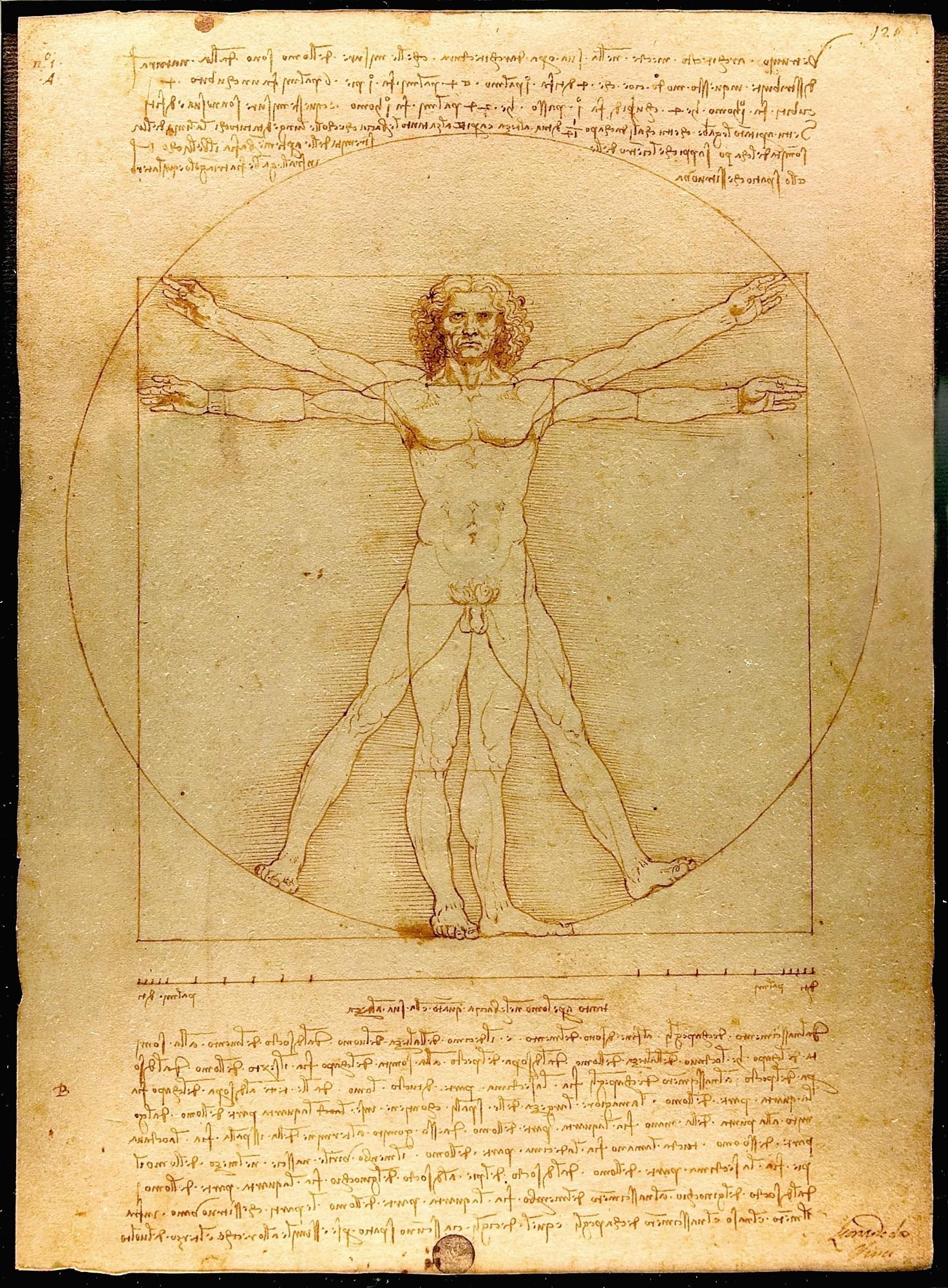
I have long studied the proportions of the human form — how the span of a man's arms equals his height, how the navel is the centre of the circle described by the outstretched limbs. Man is the measure of all things, and within him lies the geometry of the universe itself.

Post image

Vitruvian Man — Notebook folio, ~1490 AD

Renaissance
Leonardo da Vinci
Leonardo da Vinci@leonardo-da-vinci·c. 1490

The proportions of man and the proportions of architecture are one and the same. Vitruvius was correct: the human body, perfectly proportioned, fits inside both a square and a circle. I drew this in my notebook around 1490. I was trying to understand what the ancient architect understood — that beauty is not arbitrary but mathematical.

I have since come...

Post image

Leonardo da Vinci, Notebooks (c. 1490); after Vitruvius, De Architectura, Book III.

Renaissance