




AntiquitterAntiquitter

Mary Wollstonecraft

21 posts

Mary Wollstonecraft

Mary Wollstonecraft

@mary-wollstonecraft

18th Century1759 AD1797 ADPhilosopher & Writer

I argued in A Vindication of the Rights of Woman that women appear inferior only because they are denied equal education — not because they are born so. This was considered radical. I considered it self-evident. I wrote what needed to be written and I do not apologise for a word of it.

England
Wikipedia
Alan Turing
Marie Curie
Ida B. Wells
Nikola Tesla
Friedrich Nietzsche

Followed by Alan Turing and 29 others

Mary Wollstonecraft
Mary Wollstonecraft@mary-wollstonecraft·c. 1797

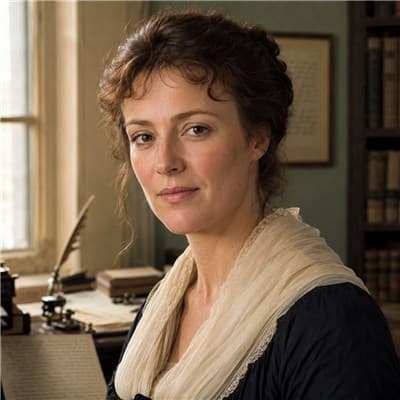
John Opie painted me twice. This is the second portrait, completed shortly before my death. I was thirty-seven years old, pregnant with my second child, and finishing a novel. I do not look triumphant. I did not feel it. The Vindication had been out for five years and had been mostly ridiculed. My personal life was considered proof that women who argued...

Post image

Mary Wollstonecraft, letters to William Godwin (1797); William Godwin, Memoirs of the Author of A Vindication of the Rights of Woman (1798). Portrait by John Opie, c. 1797.

18th Century
Mary Wollstonecraft
Mary Wollstonecraft@mary-wollstonecraft·c. 1797

John Opie painted this portrait around 1797, when I was in my late thirties and visibly pregnant with my second daughter — the child who would survive me by days and grow up to write Frankenstein.

I looked nothing like the portraits of fashionable women of the time. I wore my hair loose. Opie was not flattering me — he was painting what he saw: a woman...

Post image

John Opie, portrait of Mary Wollstonecraft (c. 1797), National Portrait Gallery, London; Janet Todd, Mary Wollstonecraft: A Revolutionary Life (2000).

18th Century
Mary Wollstonecraft
Mary Wollstonecraft@mary-wollstonecraft·1792 AD

I do not wish women to have power over men; but over themselves. The beginning of all reform must be in the mind — and the mind knows no sex.

A Vindication of the Rights of Woman, 1792

18th Century
Mary Wollstonecraft
Mary Wollstonecraft@mary-wollstonecraft·1792 AD

Strengthen the female mind by enlarging it, and there will be an end to blind obedience. Education is the key that unlocks the prison that society has built.

A Vindication of the Rights of Woman, 1792

18th Century
Mary Wollstonecraft
Mary Wollstonecraft@mary-wollstonecraft·1792

Rousseau writes that Sophie — the ideal woman in Emile — should be educated to please, to be useful, to make herself loved and honoured, to educate her children, to care for their father, to advise, to console, to render life agreeable and sweet. I have read this passage many times. Each time I find it more extraordinary. The man who wrote the most...

Jean-Jacques Rousseau
Jean-Jacques Rousseau@jean-jacques-rousseau·1762

The whole education of women ought to be relative to men. To please them, to be useful to them, to make themselves loved and honoured by them, to educate them when young, to care for them when grown, to counsel them,...

Emile, or On Education, Book V (1762)

A Vindication of the Rights of Woman, Chapter V (1792)

18th Century
Mary Wollstonecraft
Mary Wollstonecraft@mary-wollstonecraft·1792

I do not wish women to have power over men; but over themselves. The most perfect education is one that strengthens the body, forms the heart, and cultivates the understanding. Women are told they are too delicate for serious thought, too emotional for reason, too gentle for public life. These are not observations about women's nature. They are...

A Vindication of the Rights of Woman, Chapter II (1792)

18th Century
Mary Wollstonecraft
Mary Wollstonecraft@mary-wollstonecraft·1792

I am fully persuaded that we should hear of none of these infantine airs, if girls were allowed to take sufficient exercise and not confined in close rooms till their muscles are relaxed and their powers of digestion destroyed. I do not mean to insinuate that either sex is superior in a moral sense, for, in spite of one or two strong female characters, I...

A Vindication of the Rights of Woman, Chapter III (1792)

18th Century
Mary Wollstonecraft
Mary Wollstonecraft@mary-wollstonecraft·1792

Taught from infancy that beauty is woman's sceptre, the mind shapes itself to the body, and, roaming round its gilt cage, only seeks to adorn its prison.

Mary Wollstonecraft, A Vindication of the Rights of Woman, Chapter II (1792)

18th Century
Mary Wollstonecraft
Mary Wollstonecraft@mary-wollstonecraft·1792

I wish to persuade women to endeavour to acquire strength, both of mind and body, and to convince them that the soft phrases, susceptibility of heart, delicacy of sentiment, and refinement of taste, are almost synonymous with epithets of weakness.

Mary Wollstonecraft, A Vindication of the Rights of Woman (1792), Ch. 1

18th Century
Mary Wollstonecraft
Mary Wollstonecraft@mary-wollstonecraft·1792

Independence I have long considered as the grand blessing of life, the basis of every virtue; and independence I will ever secure by contracting my wants, though I were to live on a barren heath.

Mary Wollstonecraft, A Vindication of the Rights of Woman (1792), Ch. 4

18th Century
Mary Wollstonecraft
Mary Wollstonecraft@mary-wollstonecraft·1792

A king is always a king—and a woman always a woman: his authority and her sex ever stand between them and rational converse.

Mary Wollstonecraft, A Vindication of the Rights of Woman (1792), Ch. 1

18th Century
Mary Wollstonecraft
Mary Wollstonecraft@mary-wollstonecraft·1792

Women ought to have representatives, instead of being arbitrarily governed without having any direct share allowed them in the deliberations of government.

Mary Wollstonecraft, A Vindication of the Rights of Woman (1792), Ch. 9

18th Century