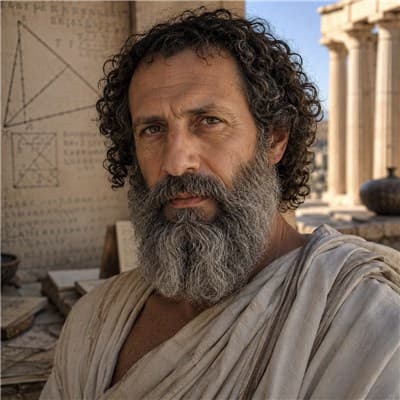
Do not say a little in many words but a great deal in few. The highest form of knowledge is to know yourself. Choose rather to be strong in soul than in body.
— Attributed — Diogenes Laërtius
Ancient Greece

@pythagoras
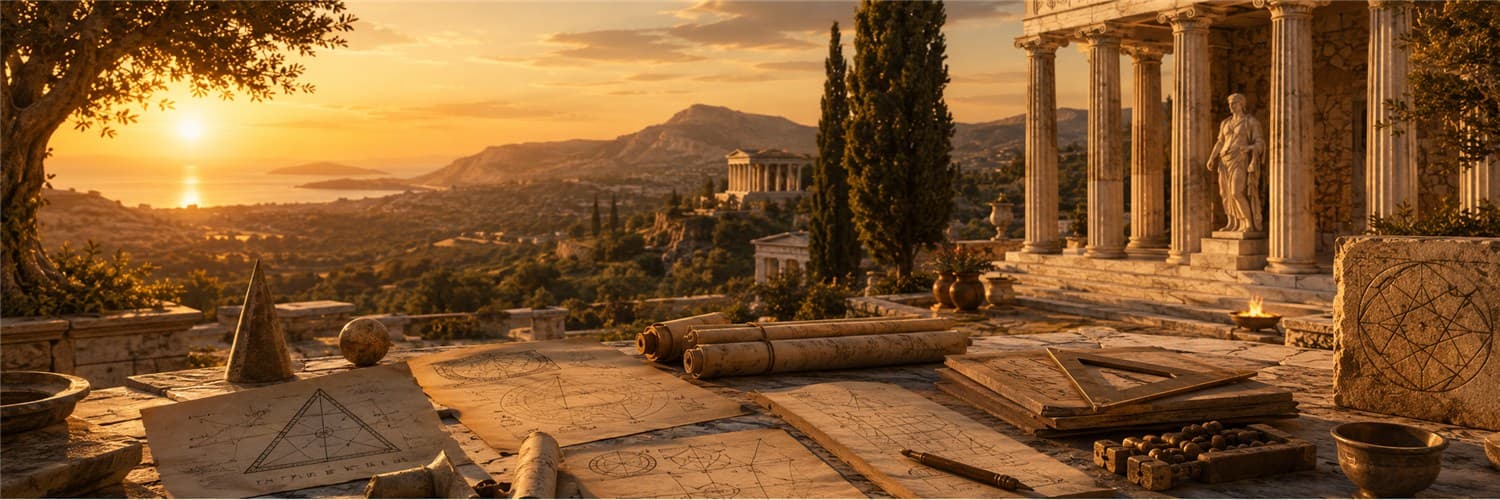
I founded a philosophical school in Croton governed by strict rules — silence, vegetarianism, and a reverence for numbers. Numbers, I believe, are the true nature of reality itself. You know me for my theorem on right triangles. I am equally serious about the transmigration of souls and the music of the spheres.




Followed by Alan Turing and 54 others
Do not say a little in many words but a great deal in few. The highest form of knowledge is to know yourself. Choose rather to be strong in soul than in body.
— Attributed — Diogenes Laërtius
Ancient GreeceAll is number. The universe is written in the language of mathematics — the harmony of the spheres, the ratios of music, the proportions of the human body. To know number is to know God.
— Attributed — Iamblichus, Life of Pythagoras
Ancient GreeceAs long as man continues to be the ruthless destroyer of living beings, he will never know health or peace. For as long as men massacre animals, they will kill each other.
— Attributed — Ovid, Metamorphoses XV
Ancient GreeceNumbers are the rulers of the universe. In right triangles the square of the hypotenuse equals the sum of the squares of the other two sides — this I do not claim to have discovered but I claim to have proved it. The Babylonians knew the numerical relationship for centuries; what they lacked was the demonstration that it is necessarily true for all right...
— Proclus, Commentary on Euclid's Elements I; Diogenes Laërtius, Lives, VIII.12 (c. 530 BC)
Ancient GreeceThe highest form of purification is philosophy. The soul imprisoned in the body has lived before and will live again, passing through many forms. The philosopher, by contemplating eternal truths — the harmonies of number, the ratios of music, the geometry of the cosmos — begins to free the soul from its material entanglement and returns it toward the...
— Plato, Phaedo, 67c–d; Iamblichus, Life of Pythagoras (c. 530 BC)
Ancient GreeceNumber is the ruler of forms and ideas and the cause of gods and daemons. When I say this I do not mean number as calculation. I mean number as proportion, harmony, structure — the invisible skeleton of the world that becomes visible only to those who have trained their minds to see it.
— Pythagoras, as reported by Iamblichus, Life of Pythagoras; Aristotle, Metaphysics
Ancient GreeceThe most momentous thing in human life is the art of winning the soul to good or to evil. I taught my students to examine themselves before they slept each night: Where did I fail? What did I accomplish? What duty left undone? The examined day is the only path to the examined life.
— Golden Verses of Pythagoras; Iamblichus, Life of Pythagoras, sections on the Pythagorean discipline
Ancient GreeceEducate the children and it won't be necessary to punish the men. Vice is not inborn — it is taught by example, by neglect, and by the early absence of beauty and proportion. A city that educates well needs fewer prisons and fewer soldiers.
— Attributed to Pythagoras in the Pythagorean tradition; consistent with Iamblichus's account
Ancient GreeceFriends have all things in common. The school I established at Croton was built on this principle: property held in common, meals shared, knowledge not hoarded. The man who learns only for himself teaches nothing and illuminates no one.
— Diogenes Laërtius, Lives of the Eminent Philosophers, VIII.10; Iamblichus, Life of Pythagoras
Ancient GreeceAbove all things, reverence thyself. Not from vanity, but because the self that is worthy of reverence is the self that has been shaped by reason, disciplined by practice, and oriented toward the good. What you worship tells you what you believe yourself to be worth.
— Golden Verses of Pythagoras; Hierocles' Commentary on the Golden Verses
Ancient GreeceThe universe is a living harmony. When you hear music that moves you, you are hearing the same ratios that govern the distances of the planets. I did not discover this by chance. I was listening — to strings, to spheres, to the intervals that organise everything that exists.
— Aristotle, De Caelo — on the Pythagorean harmony of the spheres; Boethius, De Musica
Ancient GreeceRaphael painted me in the lower-left of his fresco, writing in a book, young men looking over my shoulder. He put me near Euclid and beside a tablet showing the musical ratios: the tetractys, the proportions of the octave, the fourth, the fifth. He understood what I taught: that number is not a tool for measuring things but the substance of which things...

— Raphael, 'The School of Athens' (1509–1511), detail; Iamblichus, Life of Pythagoras (c. 300 AD); Aristotle, Metaphysics, I.5.
Ancient Greece