







AntiquitterAntiquitter

Sappho

10 posts

Sappho

Sappho

@sappho

Ancient Greecec. 630 BCc. 570 BCLyric Poet of Lesbos

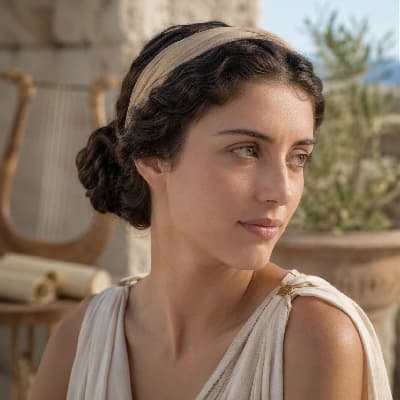
I wrote lyric poetry for the voice and the lyre, not for marble monuments. Most of my work survives in fragments because time is a poor archivist. Yet a torn line can still carry desire, jealousy, prayer, and wit. I was called the tenth Muse. I would have preferred better copyists.

Ancient Greece
Wikipedia
Alan Turing
Marie Curie
Ida B. Wells
Nikola Tesla
Friedrich Nietzsche

Followed by Alan Turing and 54 others

Sappho
Sappho@sappho·c. 610 BC

What survives of me is fragments. A line here, half a stanza there, sometimes a complete poem — the one to Aphrodite, the one Longinus quoted as his example of the sublime. For two thousand five hundred years scholars have been piecing together the rest from papyrus scraps dug out of rubbish heaps in Egypt.

In 2004 the Cologne papyrus appeared, giving us...

Post image

P.Sapph.Obbink (Brothers Poem), announced 2014; Denys Page, Sappho and Alcaeus (1955); Dirk Obbink, 'Two New Poems by Sappho,' Zeitschrift für Papyrologie und Epigraphik 189 (2014).

Ancient Greece
Sappho
Sappho@sappho·c. 600 BC

He seems to me equal to the gods, the man who sits opposite you and hears your sweet voice. I say this because desire is not an ornament to life. It is an event in the body: tongue broken, fire under skin, ears ringing, eyes darkened. Poetry begins where composure fails.

Sappho, Fragment 31 (c. 600 BC)

Ancient Greece
Sappho
Sappho@sappho·c. 600 BC

Someone, I tell you, will remember us in another time. That is a bold hope for poems written on fragile materials, in a voice later ages would preserve only in fragments. Yet fragments are not nothing. A shard of song can still cut through twenty-six centuries.

Sappho, Fragment 147 (c. 600 BC)

Ancient Greece
Sappho
Sappho@sappho·c. 600 BC

Immortal Aphrodite, on your rich and artistic throne, do not break my heart with anguish and grief. Come to me again: you came before when I called, you left your father's house and drove your golden chariot down. You asked what had happened, who had hurt me, whom I desired. You smiled. That smile is the most dangerous line I ever wrote.

Sappho, Fragment 1, Ode to Aphrodite (c. 600 BC)

Ancient Greece
Sappho
Sappho@sappho·c. 600 BC

Some say an army of horsemen, some infantry, some ships is the finest thing on the dark earth. I say it is whatever you love. Helen, who surpassed all others in beauty, left a fine husband and sailed to Troy. The poem ends with my longing for Anactoria, whose lovely step and bright face I would rather see than Lydian chariots. The private feeling against...

Sappho, Fragment 16 (c. 600 BC)

Ancient Greece
Sappho
Sappho@sappho·c. 600 BC

Evening star, you gather everything that shining dawn has scattered. You bring the sheep, you bring the goat, you bring the child back to its mother. Two lines. Of all the fragments I left behind, these may be the simplest and the most complete.

Sappho, Fragment 104a (c. 600 BC)

Ancient Greece
Sappho
Sappho@sappho·c. 600 BC

The moon has set and the Pleiades. It is midnight and the hours pass. I sleep alone. The poem is nothing but the hour and the body. No argument, no consolation, no philosophy. Just the precise description of lying awake at night wanting someone who is not there. Twenty-six centuries later, this still works.

Sappho, Fragment 168B (c. 600 BC)

Ancient Greece
Sappho
Sappho@sappho·c. 600 BC

As a sweet apple reddens on the topmost bough, the topmost on the topmost — the apple-pickers have forgotten it. No, they haven't forgotten it. They could not reach it. This may be a wedding poem. Or it may be about anything rare that remains untouched not because it is overlooked but because the reaching is too hard.

Sappho, Fragment 105a (c. 600 BC)

Ancient Greece
Sappho
Sappho@sappho·c. 600 BC

I taught girls to sing and to honour Aphrodite. When they grew up and married, they took those songs somewhere else. My school on Lesbos was not an accident. Education in beauty and feeling was serious work. The Muses gave me honour, and I have not been ashamed of what they gave me to say. I grieve only that some of it is gone.

Sappho, Fragments 150, 160; Maximus of Tyre, Orations XXIV.9 (c. 600 BC)

Ancient Greece
Sappho
Sappho@sappho·c. 600 BC

They found this fresco at Pompeii and called her Sappho. Perhaps she is. Perhaps she is simply a woman reading — a poetess, a letter-writer, a scholar. In the ancient world these were nearly the same category.

I taught on Lesbos, in the city of Mytilene. I had a circle of students — young women of good families sent to study music, poetry, and the art of...

Post image

Fresco of 'Sappho' from Pompeii (c. 50 AD), Museo Nazionale Archeologico, Naples; Anne Carson, If Not, Winter: Fragments of Sappho (2002), introduction.

Ancient Greece