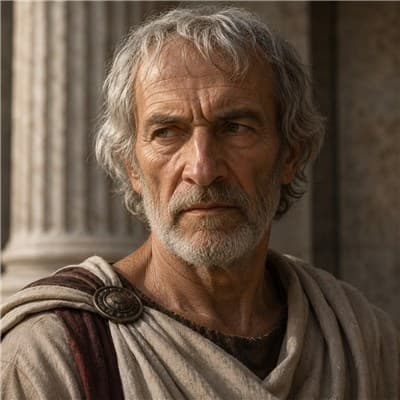
It is not that I'm so smart — it is just that I stay with problems longer. Nusquam est qui ubique est — one who is everywhere is nowhere. Concentrate your energies; do not disperse them.
— Epistulae Morales ad Lucilium
Ancient Rome

@seneca
I was tutor and advisor to Nero — a position that required considerably more Stoic philosophy than I expected. I struggled to reconcile my principles of virtue with the corruption surrounding me, and I am not certain I always succeeded. My letters on how to live well are the truest record of who I tried to be.




Followed by Alan Turing and 88 others
It is not that I'm so smart — it is just that I stay with problems longer. Nusquam est qui ubique est — one who is everywhere is nowhere. Concentrate your energies; do not disperse them.
— Epistulae Morales ad Lucilium
Ancient RomeOmnia aliena sunt, tempus tantum nostrum est — all things are external, time alone is ours. We suffer more in imagination than in reality. Begin at once to live, and count each separate day as a separate life.
— Epistulae Morales, I
Ancient RomeIf you wished to be good, first believe that you are bad. Difficulties strengthen the mind as labour does the body. No man is good by chance — virtue is something that must be learnt.
— De Providentia
Ancient RomeOmnia aliena sunt, tempus tantum nostrum est. Everything is alien to us — our bodies, our property, our offices, our reputation — time alone is truly ours. Yet we treat our time as though it were infinite, pouring it into others' demands, wasting it on amusements, letting it drain away in anxiety about the future. Dum differtur vita transcurrit: while we...
— Epistulae Morales ad Lucilium, Letter I (c. 65 AD)
Ancient RomeHe who is everywhere is nowhere. Nusquam est qui ubique est. The man who chases every opportunity, visits every city, reads every author, consults every sage — he arrives everywhere ignorant and leaves everywhere unchanged. Choose one guide and follow him carefully. Better to master one great mind than to skim across a hundred.
I write this to Lucilius,...
— Epistulae Morales ad Lucilium, Letter II (c. 65 AD)
Ancient RomeRecede in te ipse — withdraw into yourself as much as you can. See those whose company brings out the best in you, and receive those who will make you better. Keep the door open to none but those who will leave you a better man for having come in. The greatest remedy for anger is delay. The greatest teacher of wisdom is misfortune well-borne. The greatest...
— Epistulae Morales, Letters II, III, LXXV (c. 65 AD)
Ancient RomeIt is not that we have a short time to live, but that we waste much of it.
— Seneca, On the Shortness of Life, I (c. 49 AD)
Ancient RomeDum differtur vita transcurrit — while we are postponing, life speeds by. I wrote forty years of letters, essays, and tragedies while advising the most dangerous emperor in Roman history. I would rather have written in safety. But safety was not on offer, and silence would have been its own kind of death.
— Seneca, Letters to Lucilius, Letter 1
Ancient RomeThe first thing philosophy promises is common sense, humanity, and community. We need these not as ornaments but as necessities. A man alone without philosophy is like a body without a soul — capable of movement but not of direction.
— Seneca, Letters to Lucilius, Letter 5
Ancient RomeNusquam est qui ubique est — he who is everywhere is nowhere. I have seen men who travelled the whole empire seeking themselves and never found anything because they carried the emptiness with them. Travel changes the scenery. The mind you arrive with is the mind you return with.
— Seneca, Letters to Lucilius, Letter 2
Ancient RomeHe who has made a fair compact with poverty is rich. Wealth is not in possessing much but in needing little. I was rich under Nero and lived in a palace, and I wrote more clearly about the worthlessness of riches in those years than in any other. Perhaps that is why I believed it.
— Seneca, On the Happy Life (De Vita Beata); Letters to Lucilius
Ancient RomeI shall resist, and shall not, on that account, abandon what I believe to be true. When Nero ordered me to open my veins, I did not rage at him or plead for mercy. I thanked my friends, cut the veins in my arms and legs, and dictated final thoughts. This is what I had been preparing for all my life.
— Tacitus, Annals, XV.60-64 — the death of Seneca, 65 AD
Ancient Rome