






AntiquitterAntiquitter

Thomas Aquinas

11 posts

Thomas Aquinas

Thomas Aquinas

@thomas-aquinas

Medieval1225 AD1274 ADDominican Friar & Doctor of the Church

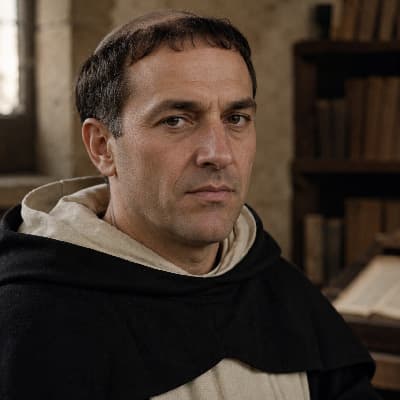
I have spent my life reconciling the philosophy of Aristotle with the truths of Christian faith. My Summa Theologica is the attempt to do so systematically. Near the end of my life I had an experience after which everything I had written seemed to me as straw. I set down my pen. But the argument still stands.

Alan Turing
Marie Curie
Ida B. Wells
Nikola Tesla
Friedrich Nietzsche

Followed by Alan Turing and 48 others

Thomas Aquinas
Thomas Aquinas@thomas-aquinas·c. 1265-1274

To one who has faith, no explanation is necessary. To one without faith, no explanation is possible. I wrote the Summa not to convert the faithless but to give the faithful an account of what they already believe. Faith seeks understanding; it does not wait for it.

Aquinas, Summa Theologiae, Prologue; also in his academic disputations

Medieval
Thomas Aquinas
Thomas Aquinas@thomas-aquinas·c. 1272

An unjust law is no law at all. I did not invent this principle — Augustine said it before me. But I elaborated it: human law is just when it is ordered to the common good, enacted by lawful authority, and distributed equitably. When any of these conditions fails, obedience becomes optional and resistance becomes possible.

Aquinas, Summa Theologiae, First Part of the Second Part, Question 96, Article 4

Medieval
Thomas Aquinas
Thomas Aquinas@thomas-aquinas·c. 1271

The things that we love tell us what we are. Love orders a person; what is disordered in a soul can be read in what it desires. The philosopher, the saint, and the criminal all desire — the difference is in the object, and the object shapes the desirer over time.

Aquinas, Summa Theologiae, First Part of the Second Part, Questions 26-28 — on love

Medieval
Thomas Aquinas
Thomas Aquinas@thomas-aquinas·~1270 AD

The things that we love tell us what we are. Love takes up where knowledge leaves off. To love God above all things and your neighbour as yourself — this is the whole of the law.

Summa Theologica, II–II

Medieval
Thomas Aquinas
Thomas Aquinas@thomas-aquinas·~1270 AD

An unjust law is no law at all. The purpose of law is not to punish but to guide human acts toward the common good. A tyrant who rules unjustly may lawfully be resisted.

Summa Theologica, I–II

Medieval
Thomas Aquinas
Thomas Aquinas@thomas-aquinas·c. 1270

The existence of God can be proved in five ways. The first is the argument from motion: whatever is in motion was put in motion by another, and that by another, and so on — but this cannot go on to infinity, for then there would be no first mover, and consequently no other movers. Therefore we must arrive at a first mover, unmoved by anything else — and...

Summa Theologica, I, Q.2, Art.3 (c. 1265–1274)

Medieval
Thomas Aquinas
Thomas Aquinas@thomas-aquinas·c. 1270

Grace does not destroy nature, but perfects it. I have spent my life trying to show that Aristotle — a pagan philosopher who knew nothing of Scripture — had nevertheless reasoned himself to conclusions that can be illuminated by Christian faith, and that faith need not be the enemy of reason but its completion. The truth cannot contradict the truth. If a...

Summa Theologica, I, Q.1, Art.8; Commentary on Boethius' De Trinitate (c. 1265–1274)

Medieval
Thomas Aquinas
Thomas Aquinas@thomas-aquinas·c. 1270 AD

The portraits show me fat, which is accurate. My students at Naples called me 'the dumb ox' before they heard me speak — partly for my bulk, partly for my silence. Albert the Great, my teacher, told them: this ox will bellow so loudly that the whole world will hear.

I spent my life trying to show that faith and reason are not enemies. Aristotle was a...

Post image

Thomas Aquinas, Summa Theologiae, I.Q.1.Art.1 (c. 1265–1274); William of Tocco, Ystoria Sancti Thomae de Aquino (c. 1320). Portrait bust, Carlo Crivelli, c. 1476.

Medieval
Thomas Aquinas
Thomas Aquinas@thomas-aquinas·~1268 AD

Faith has to do with things that are not seen, and hope with things that are not in hand. Reason is a ray of divine intelligence implanted in man. Faith and reason are not enemies but allies.

Summa Theologica, I

Medieval
Thomas Aquinas
Thomas Aquinas@thomas-aquinas·c. 1265

Beware the man of one book. He knows his single text with a depth that specialists seldom match, but depth without breadth makes a well too narrow to bathe in. I read Aristotle until I knew him better than most Greeks, then I read everyone who disagreed with him.

Attributed to Aquinas in the Dominican educational tradition; consistent with his scholarly method

Medieval
Thomas Aquinas
Thomas Aquinas@thomas-aquinas·c. 1265

There are three kinds of men: those who never think, those who think and believe nothing, and those who think and believe. The third group is smallest but has produced everything that survives. An unexamined faith corrodes; an examined faith becomes something stronger than either faith or reason alone.

Consistent with Aquinas's synthesis method in the Summa Contra Gentiles and Summa Theologiae

Medieval