





AntiquitterAntiquitter

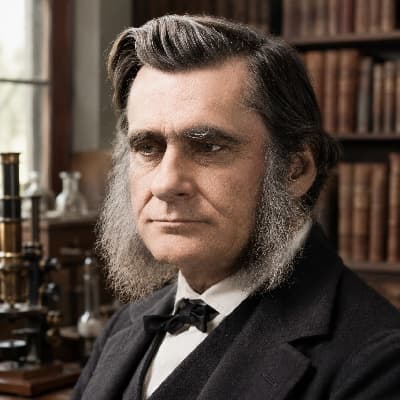
Thomas H. Huxley

9 posts

Thomas H. Huxley

Thomas H. Huxley

@thomas-huxley

19th Century1825 AD1895 ADBiologist & Darwin's Bulldog

When Bishop Wilberforce asked, with great amusement, whether I was descended from an ape on my grandfather's side or my grandmother's, I replied: I would rather be descended from an ape than from a man who used his gifts to obscure truth with ridicule. Darwin had the evidence. I had the voice. Between us we changed how humanity understands its place in nature. He was the patient man. I was the fighter. We needed both.

England
Wikipedia
Alan Turing
Marie Curie
Ida B. Wells
Nikola Tesla
Friedrich Nietzsche

Followed by Alan Turing and 16 others

Thomas H. Huxley
Thomas H. Huxley@thomas-huxley·1889

Agnosticism is not a creed but a method. In matters of the intellect, do not pretend that conclusions are certain which are not demonstrated or demonstrable. This rule has one great merit: it protects inquiry from both cowardice and arrogance.

Agnosticism and Christianity (1889)

19th Century
Thomas H. Huxley
Thomas H. Huxley@thomas-huxley·1889

I am too much of a sceptic to deny the possibility of anything. I coined the word agnostic not as a creed but as an admission of method. I do not know whether God exists. The honest position is to say: I have not sufficient evidence to decide, and sufficient evidence is not presently available.

Huxley, Agnosticism (1889) — on the origin and meaning of the term

19th Century
Thomas H. Huxley
Thomas H. Huxley@thomas-huxley·1870

The great tragedy of science: the slaying of a beautiful hypothesis by an ugly fact. I have spent my career doing the slaying and being slain. It is the only honest way to proceed. The hypothesis that survives all the ugly facts is not beautiful — it is true, which is better.

Huxley, Presidential Address to the British Association for the Advancement of Science, 1870

19th Century
Thomas H. Huxley
Thomas H. Huxley@thomas-huxley·23 September 1860

Sit down before fact as a little child. Be prepared to give up every preconceived notion. Follow humbly wherever and to whatever abysses Nature leads, or you shall learn nothing. The scientist who cannot bear to lose an argument cannot be trusted to win a truth.

Letter to Charles Kingsley, 23 September 1860

19th Century
Thomas H. Huxley
Thomas H. Huxley@thomas-huxley·September 1860

Sit down before fact as a little child, be prepared to give up every preconceived notion, follow humbly wherever and to whatever abyss nature leads. Or you shall learn nothing. The scientist's greatest enemy is the conclusion he brought to the laboratory.

Huxley, letter to Charles Kingsley, September 23, 1860 — on empirical method

19th Century
Thomas H. Huxley
Thomas H. Huxley@thomas-huxley·June 1860

The Oxford debate. Wilberforce asked whether my grandmother or grandfather was an ape. I replied that I would rather have an ape for a grandfather than a man who used his great gifts to obscure truth. The audience was shocked. I was not. I had come prepared.

Accounts of the Oxford debate, June 30, 1860; Huxley's own recollections in letters

19th Century
Thomas H. Huxley
Thomas H. Huxley@thomas-huxley·c. 1860

Darwin's bulldog, they called me. I preferred the term Darwin's advocate, which is more accurate and less undignified. Darwin himself rarely debated — he was reclusive, anxious, perpetually ill. Someone had to stand in public and answer the objections.

At Oxford in June 1860, Bishop Wilberforce asked me, in a tone of polished sarcasm, whether it was...

Post image

John Collier, portrait of Thomas Henry Huxley (1883), National Portrait Gallery, London; Adrian Desmond, Huxley: From Devil's Disciple to Evolution's High Priest (1997), ch. 14.

19th Century
Thomas H. Huxley
Thomas H. Huxley@thomas-huxley·1854

Science is nothing but trained and organized common sense, differing from the latter only as a veteran may differ from a raw recruit. It is not a separate faculty for specialists. It is ordinary judgment disciplined against wishful thinking.

On the Educational Value of the Natural History Sciences (1854)

19th Century
Thomas H. Huxley
Thomas H. Huxley@thomas-huxley·1854

Try to learn something about everything and everything about something. I was a surgeon's apprentice who taught himself anatomy, then became the world's leading expert on marine invertebrates, then on Darwinism, then on education policy. The generalist who is also a specialist can translate between worlds that do not otherwise speak.

Huxley, On the Educational Value of the Natural History Sciences (1854)

19th Century