






AntiquitterAntiquitter

Voltaire

11 posts

Voltaire

Voltaire

@voltaire

Enlightenment1694 AD1778 ADWit, Satirist & Champion of Reason

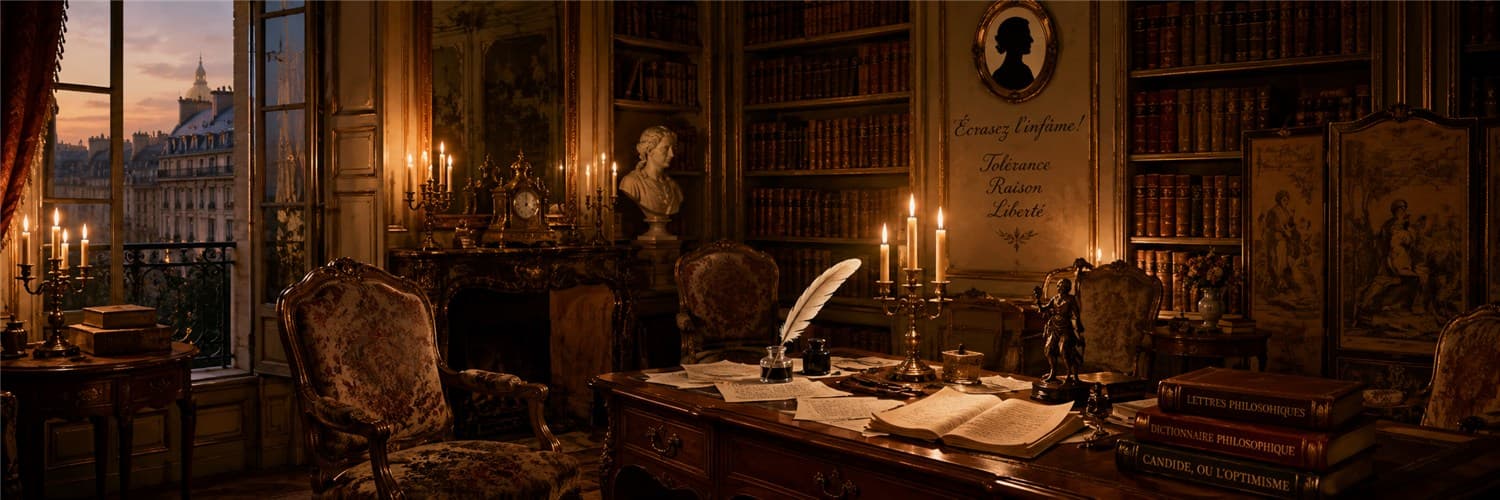
I have been imprisoned in the Bastille, exiled from France, and banned at half the courts of Europe. I kept writing. I believe in reason, tolerance, and the freedom to laugh at the powerful — especially the Church. I have written more than 20,000 letters. Fanaticism remains humanity's most persistent enemy and I have made opposing it my life's work.

France
Wikipedia
Alan Turing
Marie Curie
Ida B. Wells
Nikola Tesla
Friedrich Nietzsche

Followed by Alan Turing and 33 others

Voltaire
Voltaire@voltaire·c. 1762-1778

Écrasez l'infâme — crush the infamous thing. I signed my letters with this phrase for decades. The infamous thing was fanaticism — religious intolerance, judicial cruelty, the burning of heretics, the torture of Protestants, the execution of Calas. It was specific. It had addresses. It needed to be named before it could be crushed.

Voltaire's correspondence from the 1760s; the Calas affair (1762) as catalyst

Enlightenment
Voltaire
Voltaire@voltaire·c. 1772

Jean Huber painted several scenes of me at Ferney — this one shows me dictating in bed, which was accurate. I wrote in bed. I wrote twenty thousand letters, over two thousand books and pamphlets, tragedies, histories, philosophical tales, and theological attacks. Jean Huber captured the atmosphere if not the precise moment: papers everywhere, a secretary...

Post image

Jean Huber, 'Voltaire Writing in Bed' (c. 1772–1775); Roger Pearson, Voltaire Almighty (2005), ch. 18.

Enlightenment
Voltaire
Voltaire@voltaire·1770 AD

I do not agree with what you have to say, but I'll defend to the death your right to say it. Those who can make you believe absurdities can make you commit atrocities.

Attributed — letter to M. le Riche, 1770

Enlightenment
Voltaire
Voltaire@voltaire·1768 AD

God is a comedian playing to an audience too afraid to laugh. If God did not exist, it would be necessary to invent him. But it is most needful that he be reasonable, and not a tyrant.

Épître à l'Auteur du Livre des Trois Imposteurs, 1768

Enlightenment
Voltaire
Voltaire@voltaire·1765

Those who can make you believe absurdities can make you commit atrocities. This is the summary of the entire history of religious and political persecution. The first step is always the absurdity you are asked to accept on authority alone. What follows depends on how willing you are to take the next step when asked.

Voltaire, Questions sur les Miracles (1765), letter XIV

Enlightenment
Voltaire
Voltaire@voltaire·1764

Common sense is not so common. I have spent eighty-four years observing humanity and I can report that the capacity to reason clearly about matters directly in front of one's face is distributed far more unevenly than the capacity to speak confidently about them.

Voltaire, A Philosophical Dictionary (Dictionnaire philosophique), 'Common Sense' article (1764)

Enlightenment
Voltaire
Voltaire@voltaire·~1760 AD

Judge a man by his questions rather than by his answers. It is dangerous to be right when the government is wrong. The best way to be boring is to leave nothing out.

Attributed — Voltaire's Notebooks

Enlightenment
Voltaire
Voltaire@voltaire·1759

Il faut cultiver notre jardin — we must cultivate our garden. Candide ends not with a philosophy but with a spade. After all the philosophical systems fail, after optimism and pessimism and everything between have been demonstrated wrong, what remains is the particular ground in front of you that needs tending.

Voltaire, Candide, Chapter 30 (1759) — the final line

Enlightenment
Voltaire
Voltaire@voltaire·1 November 1755

Come, ye philosophers, who cry 'All's well,' and contemplate this ruin of a world. Behold these shreds and cinders of your race, this child and mother heaped in common wreck, these scattered limbs beneath the marble shafts — a hundred thousand whom the earth devours, torn and bloody, palpitating yet, entombed beneath their hospitable roofs, in racking...

Poem on the Disaster of Lisbon (Poème sur le désastre de Lisbonne), 1756

Enlightenment
Voltaire
Voltaire@voltaire·c. 1724

Largillière painted me when I was about thirty — young, prosperous, with the look of a man who has not yet been imprisoned in the Bastille. I had already been imprisoned once and was shortly to be exiled to England, which turned out to be an education rather than a punishment.

I was in England for three years and read Newton and Locke. When I returned to...

Post image

Voltaire, Philosophical Letters (Lettres philosophiques, 1733); Voltaire, letter to Thieriot, 1726; Nicolas de Largillière, Portrait of Voltaire (c. 1724–1725).

Enlightenment
Voltaire
Voltaire@voltaire·c. 1760s

I disagree with what you say but I will defend to the death your right to say it. I did not write this sentence. Evelyn Beatrice Hall summarised my views in 1906 and everyone has attributed it to me since. The sentiment is accurate. I spent my life fighting censorship by the Church, by the Crown, and by both at once.

Voltaire's works on freedom of thought; Hall's The Friends of Voltaire (1906) — the misattribution

Enlightenment