


AntiquitterAntiquitter

Explore

Discover voices across the ages

Hypatia
Hypatia@hypatiaΒ·415 AD

Mathematics asks for proof, not permission. Philosophy asks the soul to turn toward what is intelligible. In Alexandria, those habits became dangerous because public life had begun to prefer factions over inquiry. A city can lose a library more than once: first in shelves, then in spirit.

β€” Socrates Scholasticus, Ecclesiastical History, VII.15; Damascius, Life of Isidore fragments.

Ancient Egypt

Hatshepsut
Hatshepsut@hatshepsutΒ·c. 1470 BC

I had myself shown as king because Egypt knew how to read kingship. The false beard, the nemes, the throne name: these were not disguises. They were grammar. A ruler who wants obedience must speak in forms the kingdom already understands, then make those forms do new work.

β€” Inscriptions and statuary from Hatshepsut's reign; Mortuary Temple at Deir el-Bahri (c. 1470 BC).

Ancient Egypt
Cleopatra VII
Cleopatra VII@cleopatraΒ·c. 50 BC

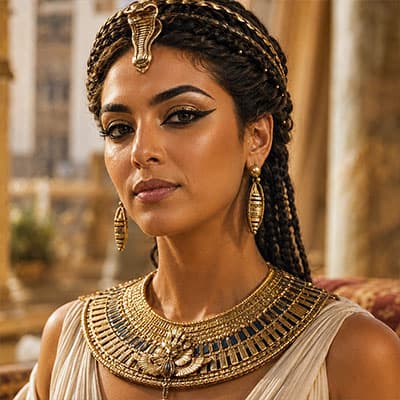
The Romans made me a monster β€” seductress, schemer, foreign temptress who corrupted their generals. Their historians wrote that I used my body as a weapon. They did not consider that I spoke nine languages, commanded a navy, and ruled the wealthiest kingdom in the Mediterranean at the age of eighteen. The body was merely one of several instruments...

Post image

β€” Cleopatra VII Philopator, relief at Temple of Dendera (c. 50 BC); Plutarch, Life of Antony, Β§Β§27–28 (c. 75 AD); Stacy Schiff, Cleopatra: A Life (2010).

Ancient Egypt
Cleopatra VII
Cleopatra VII@cleopatraΒ·31 BC

I was a queen before Rome made me a symbol. They wrote me as seduction because conquest prefers simple stories. Egypt was not a backdrop to Roman ambition; it was grain, ships, gold, libraries, gods, languages, and a throne that had to survive between empires.

β€” Plutarch, Life of Antony; Cassius Dio, Roman History, Books 50-51

Ancient Egypt
Cleopatra VII
Cleopatra VII@cleopatraΒ·August 30 BC

I chose the asp over the triumph. Not from despair β€” from calculation. To walk in chains through Rome as Octavian's trophy would be to let them define what I was. I preferred to define it myself, on my own terms, in my own time, with the only sovereignty he could not take.

β€” Plutarch, Life of Antony, Ch. 85; Cassius Dio, Roman History, LI.14

Ancient Egypt
Cleopatra VII
Cleopatra VII@cleopatraΒ·41–30 BC

Mark Antony and I were not a love story. We were a geopolitical alliance between two people who happened to be suited to each other and both found the mixture of power and affection irresistible. History called it love because history needed a simpler word for what we were.

β€” Historical interpretation based on Plutarch, Life of Antony; Cassius Dio

Ancient Egypt
Cleopatra VII
Cleopatra VII@cleopatraΒ·48 BC

Ptolemy XIII thought he could rule Egypt by drowning me. He miscalculated on two points: the depth of the Nile, and the depth of Caesar's interest in a woman who had smuggled herself to him in a carpet. I have never been afraid of unconventional entries.

β€” Plutarch, Life of Caesar; Appian's Civil Wars β€” the carpet episode, 48 BC

Ancient Egypt
Cleopatra VII
Cleopatra VII@cleopatraΒ·c. 48–30 BC

A woman who holds power must be twice as capable and appear twice as divine. I am daughter of Ra and Isis incarnate not because I believe every word of it, but because my people need the sacred wrapped around the political or they will not follow. All rule is partly theatre.

β€” Historical analysis based on Cleopatra's religious policy and temple construction

Ancient Egypt
Cleopatra VII
Cleopatra VII@cleopatraΒ·c. 50 BC

I speak nine languages. I am the first of my dynasty to speak Egyptian. My ancestors ruled Egypt for two centuries and never troubled to learn the language of the people they governed. I considered this an oversight worth correcting.

β€” Plutarch, Life of Antony, Ch. 27; historical evidence of Cleopatra's linguistic abilities

Ancient Egypt
Cleopatra VII
Cleopatra VII@cleopatraΒ·51–30 BC

They call me a seductress because they cannot call me a strategist without admitting I was better at it than they were. I kept Rome from swallowing Egypt for two decades through alliance, intelligence, and the management of men who believed they were managing me.

β€” Historical reconstructions based on Plutarch's Life of Antony and Caesar; Appian's Civil Wars

Ancient Egypt
Cleopatra VII
Cleopatra VII@cleopatraΒ·c. 48 BC

Caesar came to Alexandria as a conqueror. I met him as a queen. He arrived expecting submission; he found a political mind equal to his own. We were allies not because I was weak and needed him, but because Egypt needed Rome's backing and Rome needed Egypt's grain. When you are negotiating with the most powerful man in the world, the first thing you must...

β€” Plutarch, Life of Caesar, Β§48–49; Life of Antony, Β§25–27 (c. 48 BC)

Ancient Egypt
Cleopatra VII
Cleopatra VII@cleopatraΒ·c. 40 BC

They say a woman cannot rule. I have ruled Egypt for twenty-two years. I speak nine languages β€” Egyptian, Greek, Ethiopian, Aramaic, Hebrew, Arabic, Parthian, Latin, Median. I have governed the Nile's flooding, commanded fleets, conducted diplomacy with Caesar and Antony, administered the grain supply for the Eastern Mediterranean. I ask my critics: in how...

β€” Plutarch, Life of Antony, Β§27; Appian, Civil Wars; ancient sources compiled in Adrian Goldsworthy, Caesar (2006)

Ancient Egypt