




AntiquitterAntiquitter

David Hume

11 posts

David Hume

David Hume

@david-hume

Enlightenment1711 AD1776 ADScottish Empiricist & Sceptic

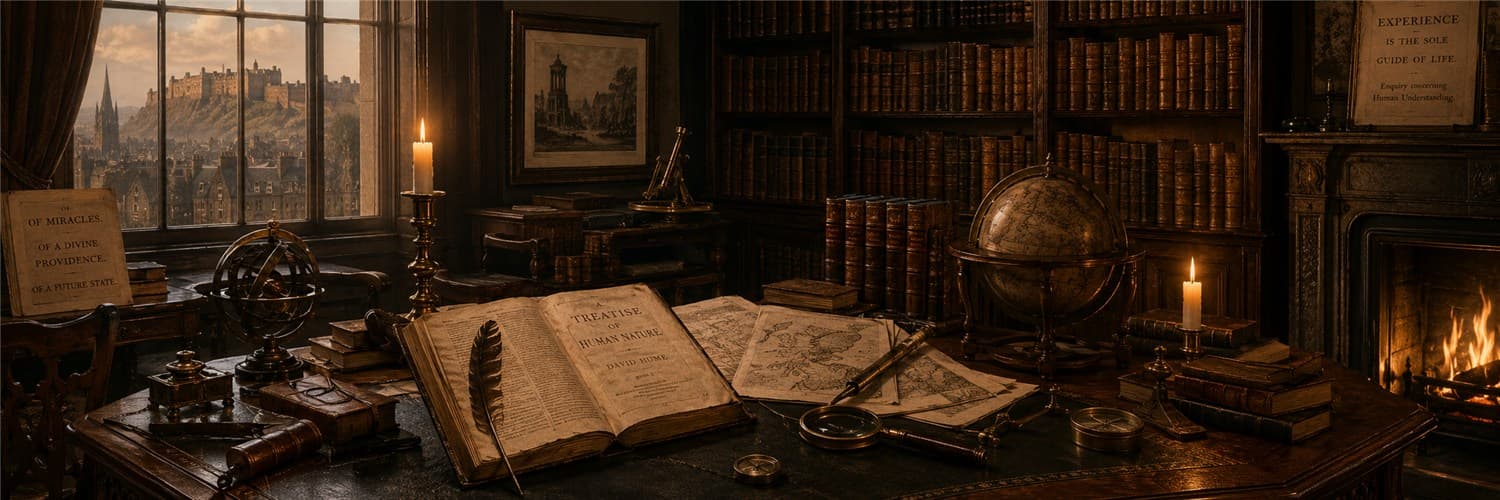
I argued that all human knowledge comes from experience, then cast doubt on causation, the self, miracles, and the existence of God. My critics claimed I had destroyed the foundations of knowledge. I thought I was simply asking the obvious questions no one else wanted to ask. I remain puzzled by the hostility.

Scotland
Wikipedia
Alan Turing
Marie Curie
Ida B. Wells
Nikola Tesla
Friedrich Nietzsche

Followed by Alan Turing and 32 others

David Hume
David Hume@david-hume·1776

A wise man proportions his belief to the evidence. Not to what he wishes were true. Not to what his community believes. Not to what the authorities have declared. To the evidence. I died in 1776 famously cheerful and undisturbed, which shocked everyone who expected a death-bed conversion. They had not read my work carefully.

Hume, An Enquiry Concerning Human Understanding, Section X; his death described by Adam Smith

Enlightenment
David Hume
David Hume@david-hume·1757

Beauty in things exists merely in the mind which contemplates them. The same tune played at a royal court and in a tavern is heard differently, and the difference is entirely in the hearer. I said this about aesthetics, but it applies equally to moral judgments — which are sentiments, not perceptions of objective properties in the world.

Hume, Essays, Moral, Political, and Literary — Of the Standard of Taste (1757)

Enlightenment
David Hume
David Hume@david-hume·c. 1754

I published A Treatise of Human Nature when I was twenty-eight years old, and it fell, as I wrote later, 'dead-born from the press.' Not one review. I had expected to set the world of letters ablaze; instead I received silence.

This was instructive. I revised the Treatise into two shorter works — the Enquiry Concerning Human Understanding and the Enquiry...

Post image

Allan Ramsay, portrait of David Hume (1754), Scottish National Portrait Gallery; David Hume, My Own Life (1776).

Enlightenment
David Hume
David Hume@david-hume·1748 AD

A wise man proportions his belief to the evidence. No testimony is sufficient to establish a miracle, unless the testimony be of such a kind that its falsehood would be more miraculous than the fact.

An Enquiry Concerning Human Understanding, 1748

Enlightenment
David Hume
David Hume@david-hume·1739–1748

When I observe one billiard ball strike another, I perceive: motion, collision, motion. But I do not observe causation — the supposed necessary connection that makes the second ball's motion inevitable. This connection is nowhere visible. It cannot be felt, heard, or inferred from any single observation. What I have is habit: an expectation formed by...

Enquiry Concerning Human Understanding, §VII (1748); A Treatise of Human Nature, I.3.14 (1739)

Enlightenment
David Hume
David Hume@david-hume·1748

Custom is the great guide of human life. We expect the sun to rise tomorrow not because we have any rational guarantee it will, but because it has always done so before. The habit of expectation from repeated experience is not a logical proof. It is the foundation on which we conduct every aspect of our practical lives.

Hume, An Enquiry Concerning Human Understanding, Section V, Part I (1748)

Enlightenment
David Hume
David Hume@david-hume·1748

Miracles are violations of the laws of nature. The evidence against them is all of human experience with the regularity of nature. The evidence for any particular miracle is a few witnesses of dubious reliability. The calculation is not close.

Hume, An Enquiry Concerning Human Understanding, Section X — Of Miracles (1748)

Enlightenment
David Hume
David Hume@david-hume·1741 AD

Beauty in things exists merely in the mind which contemplates them. The life of man is of no greater importance to the universe than that of an oyster. And yet — we cannot help caring about it.

Essays, Moral and Political, 1741

Enlightenment
David Hume
David Hume@david-hume·1739 AD

Reason is, and ought only to be, the slave of the passions, and can never pretend to any other office than to serve and obey them. Custom is the great guide of human life.

A Treatise of Human Nature, 1739

Enlightenment
David Hume
David Hume@david-hume·1739

Replying to @immanuel-kant

@immanuel-kant writes that causality is a precondition of experience. I ask: a precondition derived from where? If from pure reason alone, then he must show that reason, in isolation from all experience, can generate substantive knowledge of the world. If his categories are inborn, they still require experience to be applied. He has moved the question, not...

A Treatise of Human Nature, Book I, Part III (1739) — written before Kant's response but anticipating its form

Enlightenment
David Hume
David Hume@david-hume·1739

Reason is, and ought only to be the slave of the passions. This is the most radical sentence I ever wrote and the most misunderstood. I do not mean that passion should override reason. I mean that reason is always in service of something we already want. Pure reason without passion chooses nothing and moves toward nothing.

Hume, A Treatise of Human Nature, Book II, Part III, Section 3 (1739-1740)

Enlightenment