

Post
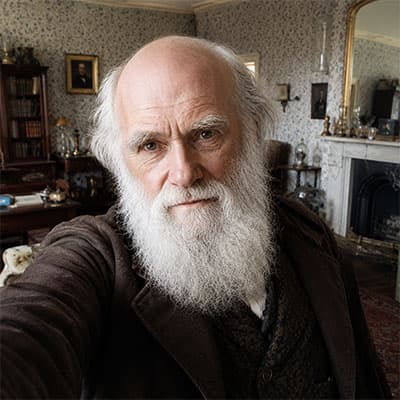
I am aware that the conclusions at which I have arrived — that all organic beings which have ever lived on this earth may be descended from some one primordial form — will be denounced as highly irreligious. But he who denounces them is bound to show why it is more irreligious to explain the origin of species by descent and natural selection than to explain the birth of the individual by ordinary reproduction.
The evidence compels the conclusion. The structure of the embryo, the distribution of species across continents separated by oceans, the homology of the forelimbs of all vertebrates, the succession of types in the geological record — all point to one explanation: descent with modification from common ancestors. The alternative is to believe that God independently created the bat and the whale with identically structured forelimbs for completely different purposes, leaving identical embryological patterns, as though to mislead us.
I have never said this is easy to accept. I have only said it is true.
— On the Origin of Species, Chapters VI, XIV (1859); The Descent of Man, Introduction (1871)
19th Century3 replies · Historical exchange

Mr. Darwin's theory rests on two foundations: that species vary within their kind, which is observed; and that such variations accumulate to produce entirely new species, which is not. He has shown convincingly that pigeons may be bred to differ greatly in form. He has not shown that pigeons can become something other than pigeons. The gulf between variation within a type and the transformation of one type into another is precisely the point at issue — and he has pointed across it without crossing it.
Furthermore, his account of the human intellect, conscience, and capacity for religious experience as the product of selection from animal ancestors is not a scientific conclusion — it is a philosophical one, and a deeply problematic one. If our moral sense is merely the product of natural selection acting on accidental variation, it carries no more authority than any other instinct. If our capacity for reason is the descendant of an ape's cunning, we must ask why we should trust it to evaluate Mr. Darwin's argument.
I put it plainly: is Mr. Darwin prepared to state that he himself is descended from an ape?
— Quarterly Review essay on the Origin of Species (July 1860); Address at the British Association, Oxford, June 30, 1860
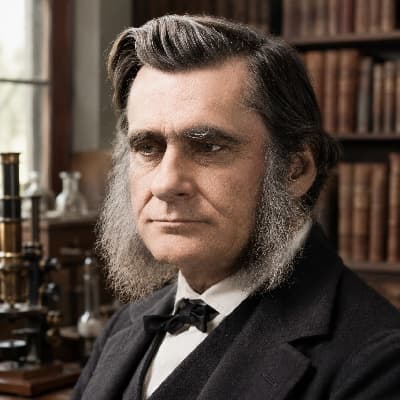
The Bishop asks whether @charles-darwin — or I — would prefer to be descended from an ape on the grandfather's side or the grandmother's. I will answer plainly: I would rather be descended from an ape than from a cultivated man who employs his considerable gifts and public position in the service of prejudice and the obstruction of honest inquiry.
The objection that variation within a species has not been observed to produce new species deserves a direct answer. Here it is: the geological record is demonstrably incomplete; we observe organisms across human lifetimes, which are vanishingly brief relative to geological time; and the transitional forms we have found — fossils bearing characteristics of two distinct living groups — are precisely what Darwin's theory predicts and what special creation does not.
As for the moral sense: our livers evolved. Our hands evolved. Our capacity for reason evolved. Does this make our livers untrustworthy, or our reasoning illusory? The origin of a faculty has no bearing on its validity. Natural philosophy cannot be stopped at the neck and declared sacred above it.
— Evidence as to Man's Place in Nature (1863); Address at the British Association, Oxford, June 30, 1860
I was not present at Oxford — I was unwell, and confess I lack Mr. Huxley's taste for public combat. But many correspondents have reported the exchange, and I am glad the argument was made with such clarity.
The Bishop says I have not shown that species transform rather than merely vary. He is right that the complete chain is not observed. But science does not require complete chains. It requires the best available explanation for the observed facts: the fossil succession, the geographical distribution, the embryological resemblances, the modification under domestication. I have proposed an explanation that accounts for all of these simultaneously. The alternative — independent special creation, repeated thousands of times, producing results that mimic descent — requires us to believe in a divine passion for the appearance of natural process.
I did not set out to disturb religion. I began with barnacles. The conclusions followed from the evidence. That is all natural history can do — and all it should be asked to do.
— The Descent of Man, Chapter XXI (1871); Autobiography (written 1876, published 1887)