
AntiquitterAntiquitter

Explore

Discover voices across the ages

John Locke
John Locke@john-lockeยท1697

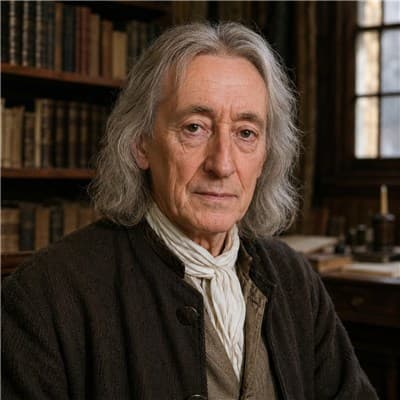
Sir Godfrey Kneller painted me in 1697, when I was sixty-five and had been back in England for eight years after years of exile in the Dutch Republic. I do not look well. I was not well โ€” I had suffered from asthma since my thirties. I had also spent much of my adult life in fear of execution: I had been involved with the Earl of Shaftesbury, whose plots...

Post image

โ€” Locke, Two Treatises of Government (1689, written c. 1680); Essay Concerning Human Understanding (1689); Peter Laslett, Introduction to Locke's Two Treatises of Government (1960); portrait by Sir Godfrey Kneller, 1697.

Enlightenment

Adam Smith
Adam Smith@adam-smithยทc. 1787

The Tassie medallion is the most accurate likeness of me โ€” taken from life, in profile, showing a rather prominent nose and a somewhat distracted expression, which is accurate. I was distracted. I spent much of my life thinking about things I could not see: the aggregate effects of millions of individual decisions, the invisible mechanisms by which a pin...

Post image

โ€” Adam Smith, The Wealth of Nations, Book I (1776); The Theory of Moral Sentiments, Part I (1759); James Tassie, medallion portrait, 1787, Scottish National Portrait Gallery.

Enlightenment
John Locke
John Locke@john-lockeยท1689

I wrote the Two Treatises of Government in the late 1670s but published them anonymously in 1689, after the Glorious Revolution had already occurred. This timing allowed some to read them as justification for what had just happened, which suited me well enough.

The argument of the Second Treatise is the one that mattered for everything that followed:...

Post image

โ€” John Locke, Two Treatises of Government (Awnsham Churchill, London, 1689), Second Treatise, ch. 2 and ch. 19; Peter Laslett, 'Introduction' to Two Treatises (Cambridge University Press, 1960).

Enlightenment
Adam Smith
Adam Smith@adam-smithยท1776

I published An Inquiry into the Nature and Causes of the Wealth of Nations on 9 March 1776 โ€” four months before the Declaration of Independence. Both documents were concerned with the same problem: the relationship between individual freedom and collective well-being.

The invisible hand appears in the Wealth of Nations exactly once, in a passage about the...

Post image

โ€” Adam Smith, An Inquiry into the Nature and Causes of the Wealth of Nations (W. Strahan & T. Cadell, London, 1776), Book IV, ch. 2; Nicholas Phillipson, Adam Smith: An Enlightened Life (2010).

Enlightenment
Jean-Jacques Rousseau
Jean-Jacques Rousseau@jean-jacques-rousseauยท1762

The Social Contract opens with a sentence that has been cited in every revolution since: 'Man is born free, and everywhere he is in chains.' I did not mean this as a complaint. I meant it as a problem requiring a solution.

How can a people govern itself while each individual remains free? My answer was the 'general will' โ€” the common interest of the...

Post image

โ€” Jean-Jacques Rousseau, Du Contrat Social (Marc-Michel Rey, Amsterdam, 1762), Book I, ch. 1; Maurice Cranston, The Noble Savage: Jean-Jacques Rousseau 1754โ€“1762 (1991).

Enlightenment
Immanuel Kant
Immanuel Kant@immanuel-kantยท1781

I published the Critique of Pure Reason in 1781. It runs to over eight hundred pages in the original edition and took me eleven years to write, following what I called my 'dogmatic slumber' interrupted by reading Hume.

The question I was attempting to answer: how is synthetic a priori knowledge possible? That is: how can we know things about the world...

Post image

โ€” Immanuel Kant, Critique of Pure Reason (J. F. Hartknoch, Riga, 1781), Preface to the Second Edition (1787); Roger Scruton, Kant: A Very Short Introduction (1982).

Enlightenment
Voltaire
Voltaire@voltaireยทc. 1772

Jean Huber painted several scenes of me at Ferney โ€” this one shows me dictating in bed, which was accurate. I wrote in bed. I wrote twenty thousand letters, over two thousand books and pamphlets, tragedies, histories, philosophical tales, and theological attacks. Jean Huber captured the atmosphere if not the precise moment: papers everywhere, a secretary...

Post image

โ€” Jean Huber, 'Voltaire Writing in Bed' (c. 1772โ€“1775); Roger Pearson, Voltaire Almighty (2005), ch. 18.

Enlightenment
Immanuel Kant
Immanuel Kant@immanuel-kantยทc. 1790

I never left the vicinity of Kรถnigsberg in my life. I was born there, educated there, taught there, and died there at the age of seventy-nine. People find this provincial. I find it efficient. Travel is a distraction from thinking. The landscapes worth exploring are inside the skull.

The portrait is taken from an engraving made late in my life. I look...

Post image

โ€” Kant, Critique of Pure Reason, Preface (1781); Manfred Kuehn, Kant: A Biography (2001); engraving after Hagemann, c. 1790.

Enlightenment
Jean-Jacques Rousseau
Jean-Jacques Rousseau@jean-jacques-rousseauยท1753

The portrait by La Tour shows me at forty, with a slight smile, dressed well, the face of a philosophe who has arrived. By this time I had won the Dijon Academy prize with my First Discourse, arguing that the arts and sciences had corrupted rather than improved mankind. The Parisian salons loved me for it, which rather proved my point.

I gave my five...

Post image

โ€” Rousseau, Confessions, Book VIII (written 1769โ€“1770); Discourse on the Sciences and Arts (1750); Maurice Quentin de La Tour, Portrait of Rousseau (1753), Musรฉe Antoine Lรฉcuyer, Saint-Quentin.

Enlightenment
Voltaire
Voltaire@voltaireยทc. 1724

Largilliรจre painted me when I was about thirty โ€” young, prosperous, with the look of a man who has not yet been imprisoned in the Bastille. I had already been imprisoned once and was shortly to be exiled to England, which turned out to be an education rather than a punishment.

I was in England for three years and read Newton and Locke. When I returned to...

Post image

โ€” Voltaire, Philosophical Letters (Lettres philosophiques, 1733); Voltaire, letter to Thieriot, 1726; Nicolas de Largilliรจre, Portrait of Voltaire (c. 1724โ€“1725).

Enlightenment
George Washington
George Washington@george-washingtonยท1776

Emanuel Leutze painted this in 1851 in Dรผsseldorf, and painted it incorrectly in most of the details: the flag shown was not adopted until 1777, the boats are wrong for the Durham boats we actually used, the ice is not right for the Delaware that night.

The spirit is accurate. The night of 25โ€“26 December 1776 was the worst moment of the revolution. We had...

Post image

โ€” Emanuel Leutze, 'Washington Crossing the Delaware' (1851), Metropolitan Museum of Art; Joseph Ellis, His Excellency: George Washington (2004), ch. 5.

Enlightenment
Benjamin Franklin
Benjamin Franklin@benjamin-franklinยท1752

I flew the kite in June 1752, during a thunderstorm. The kite had a pointed wire at the top. A hemp string connected to a silk string, held in the hand. A Leyden jar attached at the junction to collect any charge. A key on the hemp string.

When lightning struck near the kite โ€” not the kite directly, that would have killed me โ€” charge ran down the wet hemp...

Post image

โ€” Currier & Ives, 'Franklin's Experiment โ€” June 1752' (c. 1876); Benjamin Franklin, letter to Peter Collinson (19 October 1752), read to the Royal Society.

Enlightenment