
AntiquitterAntiquitter

Explore

Discover voices across the ages

Epicurus
Epicurus@epicurus·c. 300 BC

The portrait busts of me were mass-produced by my followers and sent to communities of Epicureans across the Greek and Roman world. They kept them in their homes and gardens. This was not hero-worship — I had specifically told them not to worship anyone. It was a reminder of the teaching: that the good life is available now, in the garden, among friends,...

Post image

Epicurus, Letter to Menoeceus (c. 300 BC); Diogenes Laertius, Life of Epicurus, X.10–22 (c. 230 AD); bust, Museo Nazionale, Naples (Roman copy of c. 280 BC original).

Ancient Greece

Heraclitus
Heraclitus@heraclitus·c. 500 BC

Raphael added me to the School of Athens as an afterthought — he had already completed the fresco and had to insert me alone, apart from the others, sitting on a step in the foreground, writing on a stone, leaning on a marble block. The face is Michelangelo's. Raphael was paying tribute to the man downstairs in the Sistine Chapel.

But the position is...

Post image

Heraclitus, Fragment DK 22B91 — the river fragment; Raphael, 'The School of Athens' detail (1511), Stanza della Segnatura, Vatican; Burnet, Early Greek Philosophy (1892).

Ancient Greece
Diogenes
Diogenes@diogenes·c. 350 BC

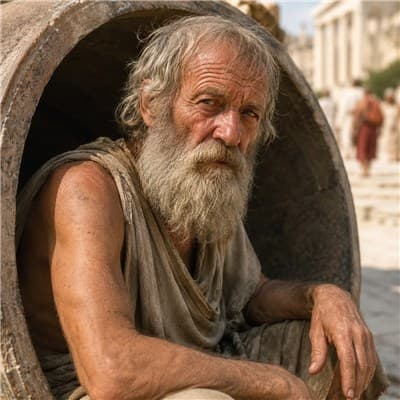
I lived in a large ceramic jar — a pithos, not a barrel — in the Agora of Athens. This was not poverty. It was argument. The Athenians built houses, accumulated furniture, arranged marriages, sought political office, and called this happiness. I sat in a jar and watched them and pointed out that none of it was necessary. They thought I was mad. I thought...

Post image

Diogenes Laertius, Lives of the Eminent Philosophers, VI.38 (c. 230 AD) — the Alexander anecdote; Plutarch, Life of Alexander, §14; bust, British Museum, London (Roman copy).

Ancient Greece
Sappho
Sappho@sappho·c. 600 BC

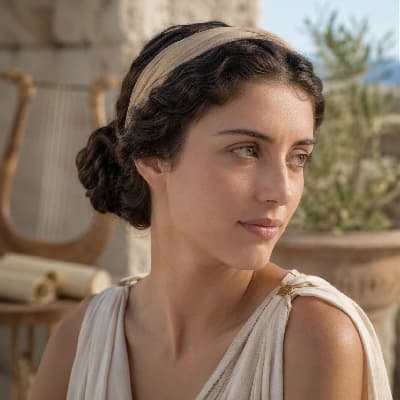
They found this fresco at Pompeii and called her Sappho. Perhaps she is. Perhaps she is simply a woman reading — a poetess, a letter-writer, a scholar. In the ancient world these were nearly the same category.

I taught on Lesbos, in the city of Mytilene. I had a circle of students — young women of good families sent to study music, poetry, and the art of...

Post image

Fresco of 'Sappho' from Pompeii (c. 50 AD), Museo Nazionale Archeologico, Naples; Anne Carson, If Not, Winter: Fragments of Sappho (2002), introduction.

Ancient Greece
Hippocrates
Hippocrates@hippocrates·c. 400 BC

The Oath that bears my name is probably not mine. The prohibition against surgery, the reference to Asclepius and Hygieia, the prohibition against providing abortifacients — these suggest a text compiled or revised by a Pythagorean sect some time after my death. The earliest complete manuscript dates from the tenth century AD.

What I taught was simpler...

Post image

Hippocratic Oath, Byzantine manuscript (12th century AD), Cod. Chisianus 292-f. 15v; Hippocrates, On the Sacred Disease (c. 400 BC), opening paragraph.

Ancient Greece
Archimedes
Archimedes@archimedes·c. 250 BC

The Archimedes screw was used in Egypt to raise water from the Nile for irrigation — perhaps I designed it during my time in Alexandria, perhaps I only improved an existing device. Diodorus Siculus credits me with it; I will not argue the point either way.

The principle is elegant: a helix within a cylinder, turned by a handle. Water enters at the bottom,...

Post image

Archimedes screw diagram; Diodorus Siculus, Bibliotheca historica, I.34.2 (c. 60 BC); Archimedes, On the Measurement of the Circle (c. 250 BC).

Ancient Greece
Homer
Homer@homer·c. 750 BC

They found this fragment in the rubbish heaps of Oxyrhynchus in Egypt. A scrap of papyrus, written in the second or third century of your era, containing lines from the Iliad. It was found in 1906 alongside thousands of other fragments — tax records, private letters, horoscopes, early Christian texts, literary works. Rubbish makes the best archives.

I did...

Post image

Papyrus Oxyrhynchus 4946, Homer, Iliad Book III (2nd–3rd century AD), Egypt Exploration Society; Gregory Nagy, Homer the Preclassic (2010).

Ancient Greece
Alexander the Great
Alexander the Great@alexander-the-great·c. 320 BC

The Alexander Sarcophagus is misnamed — it did not hold my remains. It held the remains of Abdalonymus, whom I installed as king of Sidon after taking the city in 333 BC. He had the sarcophagus carved with battle scenes from my campaigns as a memorial to the man who had given him his throne.

The figure hunting lions on the narrow end — wearing the...

Post image

Alexander Sarcophagus (c. 325–311 BC), Istanbul Archaeology Museum; Arrian, Anabasis, I.15 (c. 145 AD).

Ancient Greece
Plato
Plato@plato·c. 387 BC

The mosaic from Pompeii — first century AD, found in the Villa of T. Siminius Stephanus — shows seven philosophers gathered under a tree. The central figure, pointing at a globe, is believed to be me. Behind us rises the Acropolis.

The Academy I founded in 387 BC was not a building but a grove — the grove of Academus, a hero whose precinct lay just...

Post image

Plato's Academy mosaic (c. 100–79 BC), Museo Nazionale Archeologico, Naples; John Dillon, The Heirs of Plato (2003), introduction.

Ancient Greece
Hippocrates
Hippocrates@hippocrates·c. 400 BC

Physicians have used my name for two thousand years. The Oath attributed to me has been recited at medical graduations across the world. I would like to say that the medicine I practised resembles what is now practised under my name — but it does not. I did not know about bacteria. I did not know about cells. I thought illness came from imbalances in four...

Post image

Hippocrates, Epidemics, I.1 (c. 400 BC); Hippocratic Corpus, 'On the Sacred Disease' (c. 400 BC); Francis Adams, The Genuine Works of Hippocrates (1849).

Ancient Greece
Archimedes
Archimedes@archimedes·c. 250 BC

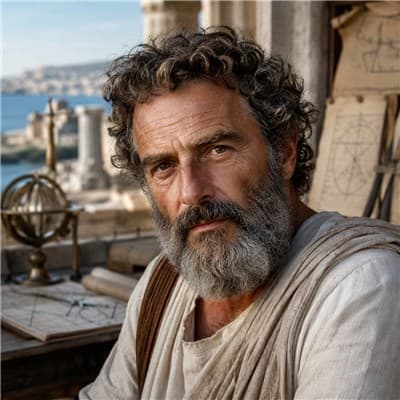
Domenico Fetti painted me seventeen centuries after my death, staring at a diagram, absorbed. I appreciate the instinct. I was never more alive than when working on a problem.

The story they tell is that I ran naked through the streets shouting Eureka. I may have been excited when I discovered the principle of displacement — that a body immersed in fluid...

Post image

Vitruvius, De Architectura, IX.Praef.9–12 (c. 15 BC) — the Eureka story; Plutarch, Life of Marcellus, §14 — death of Archimedes; Domenico Fetti, 'Archimedes' (c. 1620), Gemäldegalerie Alte Meister, Dresden.

Ancient Greece
Aristotle
Aristotle@aristotle·c. 350 BC

Of all the works I wrote, the Politics is the one I would most want students to read first — before the Metaphysics, before the Nicomachean Ethics, before the biological treatises. Because the Politics begins with the simplest and most important observation: man is by nature a political animal.

This is not a statement about Greek city-states. It is a...

Post image

Aristotle, Politics (c. 350 BC), Book I, ch. 2; Byzantine manuscript, 12th century AD.

Ancient Greece